 11
11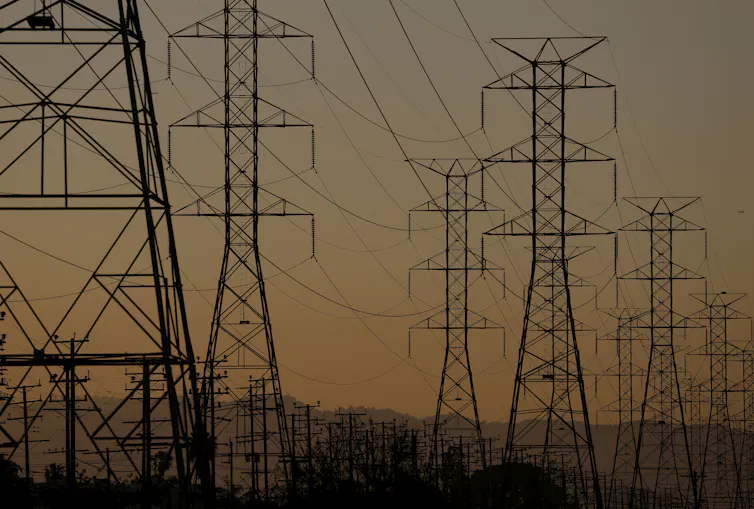
Imagine the internet as a giant library that needs big computers to work. Those big computers live in "data centers." Right now, the U.S. is building a LOT of them—and that’s causing some tricky situations with people’s land.
The artificial intelligence (AI) boom in the United States is being matched by a data center building boom. Think of a data center as a warehouse filled with computer servers that process words, images, and lines of code for large language models such as ChatGPT.
Here’s what’s happening:
There is also growing opposition to the infrastructure around them, especially the transmission lines (the wires that carry electricity) needed to power them. These lines often must cross land belonging to private citizens.
Important Point: Where private citizens refuse to sell their land, companies are turning to eminent domain—the government’s inherent power to seize private property without a landowner’s consent. But a big question is: does a line built to serve a private data center qualify?
The author of this explainer is a legal scholar who studies eminent domain issues. They say today’s fights over taking property for AI infrastructure are the latest version of a long debate: how far can the government go to take private property for "public use"?
Data centers have massive power needs. They can stress electrical grids (the network that delivers electricity) and threaten their reliability.
Across the U.S.—in states such as Georgia and Pennsylvania—power companies have looked to eminent domain to facilitate these goals.
Let’s break it down like you’re five:
The rules come from the U.S. Constitution:
Other things to know:
Even though property may only be taken for "public use," the U.S. Supreme Court has interpreted that rule loosely.
Some state supreme courts are stricter:
Important Point: Private landowners may have more success challenging land seizures under their state constitutions than in federal court. But courts typically still permit eminent domain by utilities like power companies.
When people sue to stop land seizures for transmission lines saying it’s not "public use," the results are mixed.
Examples:
These decisions suggest:
The U.S. is in a data center building frenzy, with 3,000+ built and 1,500 more coming. Most Americans don’t want them nearby due to costs and pollution. To power them, companies need transmission lines and sometimes use eminent domain (government land seizure with payment) when people refuse to sell. The Constitution allows this for "public use," and courts have loosely defined that—but states vary. Some court cases show that if a power line clearly helps local people, it’s allowed; if it only helps another state or a private center, it may not be. Landowners can sometimes challenge these takeovers, especially using state laws.
1. What is a data center in simple terms?
A data center is a building full of powerful computers (servers) that handle AI tasks like ChatGPT by processing words, images, and code. They use lots of electricity and water.
2. Can the government just take my land for a data center?
Not directly for the center itself easily—but they can take land for transmission lines (power wires) under eminent domain if it’s for "public use" and they pay you fairly. States have different rules.
3. What does "just compensation" mean?
It means the government must give the landowner a fair price for the property or easement they take.
4. Why do people oppose data centers?
They worry about higher bills, pollution, noise, lost green space, and heavy water/electricity use.
5. Can a private company take my land?
Usually only if the government gives them the power (like to a power company as a "common carrier"), and even then, it must follow public-use rules and pay you.