Emily Wilson’s Review of Christopher Nolan’s The Odyssey: A Simple Guide
About This Article
This is a beginner-friendly summary of a detailed film review by Emily Wilson—a professor and famous translator of Homer’s The Odyssey. She watched Christopher Nolan’s new $250 million movie version and wrote about what works, what doesn’t, and why it matters. We’ve translated her academic language into plain English so anyone can understand.
Quick Overview: What Is This Movie?
- Director: Christopher Nolan (Inception, Oppenheimer, The Dark Knight)
- Source Material: Homer’s ancient Greek epic poem The Odyssey (written ~700 BCE)
- Budget: $250 million
- Style: Big, loud, action-packed "spectacle" movie—think Lord of the Rings meets Game of Thrones with IMAX cameras
- Verdict: Entertaining popcorn fun, but emotionally hollow and morally confusing
How the Movie Compares to Homer’s Original Poem
The Original Poem Was Already a "Remix"
- Homer didn’t invent the story—he used a new technology (the written alphabet) to rewrite older myths
- The poem explores timeless tensions: group vs. individual, civilization vs. chaos, strangers vs. hosts
- It’s surprisingly modern: deals with migration, colonization, urbanization, and political power struggles
Nolan’s Version: "All Buffet, No Nutrition"
| Homer’s Poem |
Nolan’s Movie |
| Restrained, psychological, human-scale |
Maximalist: every second packed with noise, light, action |
| Characters have inner lives, mixed motives |
Characters are flat; motivations don’t make sense |
| Women have powerful speeches (Calypso, Penelope) |
Women are silent, decorative, or "unpaid therapists" |
| Gods are real, scary, and politically active |
Gods are missing or reduced to vague "thunder and fire" |
| Violence has consequences; victims have faces |
Violence is "righteous computer-game killing" |
| Xenia (guest-friendship) is complex sacred law |
Xenia becomes American-style "rich people being nice to poor people" |
Important Point
Adaptations don’t have to follow the original exactly. Great adaptations (like Virgil’s Aeneid, Joyce’s Ulysses, Atwood’s Penelopiad) transform the source. Nolan seems to understand this—his first film Following (1998) was all about the dangers of obsessively tracking strangers. But knowing the trap isn’t the same as avoiding it.
Characters: What Changed (and What Got Lost)
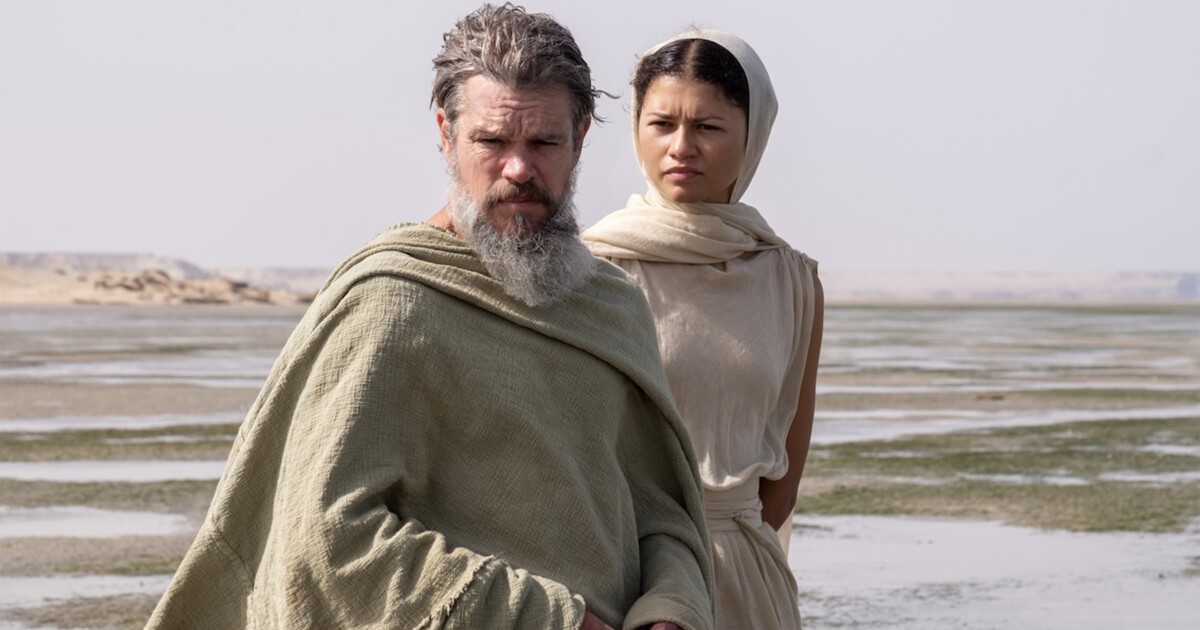
Odysseus (Matt Damon)
- In the poem: "Complicated man"—wily, artful, suppresses his desires to survive, master storyteller, skilled craftsman (polymēchania)
- In the movie: "Lummoxy" (clumsy/awkward), not clever, no "No Man" trick on Polyphemus, builds a sad driftwood raft, zero chemistry with Penelope
- Motivation: Anxiety, guilt, protecting his son—not cunning or desire for home
Penelope (Anne Hathaway)
- In the poem: Dreams of geese killed by an eagle—weeps for the suitors, showing ambivalence about Odysseus’s return
- In the movie: No dreams, no inner life, just "yearns for Matt Damon for reasons unknown"
- Visuals: Beautiful, veiled, mysterious—but script gives her nothing to do
Calypso (Charlize Theron)
- In the poem: Furious goddess who calls out divine double standards (male gods kidnap mortal women freely; goddesses get punished)
- In the movie: Gorgeous, soothing, never angry, never funny, never lustful—just a therapist with drugs
Athena (Zendaya)
- In the poem: Scheming, bloodthirsty war goddess, Odysseus’s divine patron
- In the movie: "Vulnerable victim of war" or "projection of Odysseus’s conscience"—not a goddess at all
The "Black Best Friend" Problem
- Race-neutral casting (Zendaya, Lupita Nyong’o, Himesh Patel, Corey Antonio Hawkins, Travis Scott)
- But: Non-white actors play support roles only—aid the white hero, no agency
- Travis Scott (Phemius the bard): Yells, pounds stick, never sings or plays lyre
- Lupita Nyong’o (Helen/Clytemnestra): Few minutes, "tableaux of female victims"
- Himesh Patel (Eurylochus): Anxious sidekick, uses wax for Sirens—no rivalry, no bitterness
Missing/Undermined Characters
| Character |
In Poem |
In Movie |
| Eurylochus |
Embittered rival, kills Cattle of the Sun |
Helpful bearded guy |
| Eumaeus (swineherd) |
Enslaved as child, fantasizes Odysseus will free him |
Cataracts prevent recognition; only wish: make Odysseus comfortable |
| Mentor |
Disguised Athena |
Helpful bearded guy (Ryan Hurst) |
| Nausicaa / Scheria |
Charming, mundane, human-scale episode |
Entirely cut—no room for "small moments" |
Themes & Big Ideas: A Muddled Moral Mess
1. The "Sea Peoples" Conspiracy Theory
- Movie uses a debunked 19th-century theory: "Sea Peoples" destroyed Bronze Age civilization
- Reality: Collapse caused by climate change, earthquakes, internal unrest—no mysterious invaders
- Nolan knows this but uses it for a "characteristic narrative twist" (won’t spoil it—you’ll guess it)
2. Xenia (Guest-Friendship) Gets an American Makeover
- Original: Sacred, reciprocal bond between strangers/hosts across generations
- Movie: "Wealthy people should be gracious to poor people (without fixing poverty)"
3. Moral Contradictions Galore
The film can’t decide what’s good or bad:
| Situation |
Movie Says: |
| Greeks kill Trojans (violated xenia) |
BAD |
| Odysseus kills suitors (violated xenia) |
GOOD |
| Trojans take abandoned horse |
NATURAL/FORGIVABLE |
| Suitors take Odysseus’s palace/food/wife |
UNFORGIVABLE |
| Strangers in Ithaca |
TREAT AS GODS |
| Strangers abroad |
MONSTERS: BLIND, ROB, SLAUGHTER |
| Odysseus blinds Polyphemus (defies Poseidon) |
NOBLE/BRAVE |
| Eurylochus eats Cattle of Sun (defies Helios) |
STUPID/GREEDY |
| Odysseus tricks Sinon/suitors |
BAD |
| Telemachus/Odysseus trick suitors |
GOOD |
| Sharing/equality |
GOOD (Odysseus rows with men) |
| One-man rule/monarchy |
GOOD (challengers = evil/foolish → must die) |
| Fight for new wealth (Agamemnon) |
BAD |
| Fight to keep wealth (Odysseus) |
GOOD |
Key Insight
Any one of these contradictions could make a great movie. Nolan just lets them spin in a whirlpool with no human anchor.
4. War: Bad When Others Do It, Fun When We Do It
- Trojans = faceless, masked, dehumanized
- Sack of Troy: Odysseus acts bewildered—as if he’s never seen a massacre he organized
- Suitor massacre: "Most enjoyable sequence"—exuberant, villainous Antinous (Robert Pattinson) "deserves to be stabbed"
- Film wants us horrified by war AND cheering for the bloodbath
Visuals, Sound & Style: "Fireworks Without Feeling"
Looks Like Other Modern Epics
- Land of the Dead → Game of Thrones beyond the Wall
- Giants, armies, landscapes → Peter Jackson’s Lord of the Rings
- Ending ("sail beyond the sunset") → Almost expected Elvish singing
Sound Design: Assault on the Ears
- "Full din of thumping sticks, staffs, swords, clashing armour, thunderbolts, crashing waves, grunts, screams, toppling palaces, burning temples"
- No emotional payoff—even Argos the dog’s death feels manipulated ("adorableness amped up for animal-loving times")
Dialogue: "Relentlessly Expository, Humourless, Flat"
- Modern American English is fine (Homeric Greek was already a poetic composite nobody actually spoke)
- But Nolan can’t write dialogue:
- Clunky attempts at vigor: "My dad’s coming home" / "Let’s get off this fucking beach"
- Next to grandiose nonsense: "Yes, my queen. The breaking of Zeus’ law, spreading like plague…"
The "No Man" Joke: Gone
- Poem: Odysseus tells Cyclops name is "No Man" → blinded giant screams "No Man hurts me!" → neighbors ignore him
- Movie: Cyclops is a puppet with no wits, barely speaks, no neighbors, no sheep—Odysseus doesn’t need to outwit him
The Aeneid Subplot: Sinon & the Trojan Horse
What Nolan Added (Not in Homer)
- Sinon (Elliot Page): Greek double agent from Virgil’s Aeneid who tricks Trojans into taking the Horse
- In Virgil: Ulysses = cruel, Sinon = deceitful accomplice
- In Nolan: Sinon = plucky moral center, recruited by evil draft-dodger Antinous (teen Pattinson)
- Odysseus’s arc: Guilt over lying to Sinon about the Horse plot
Why It Doesn’t Work
- Odysseus’s lie didn’t start the war
- Trojans would’ve taken the Horse anyway (per Homer)
- Sinon wants in on the scheme—but movie says sack of Troy was terrible?
- Heavy-handed modern allegory: "Lies and xenophobia of War on Terror/Brexit began cultural decline"
- Didactic, not dramatic—Nolan lectures instead of explores
The Ethical Elephant in the Room: Western Sahara
Critical Ethical Issue
Part of the film was shot in occupied Western Sahara—territory illegally occupied by Morocco since 1975, indigenous Sahrawi people displaced and oppressed.
- Using this land as a "visually striking backdrop" normalizes the occupation
- Especially galling: Film redeems a war hero for "partial acknowledgment of guilt" while ignoring real, ongoing violence
The Good News: Why This Movie Still Matters
Despite everything above, Wilson ends on a hopeful note:
- Bringing people back to cinemas in the "streaming era"
- Translations of The Odyssey (including hers) flying off shelves
- Tom Holland fans might accidentally learn ancient Greek
- College administrators might think twice before cutting classics departments
- Nolan studied English at University College London—where The Odyssey is still a first-year foundational text
- He’s getting the public reading again—and for that, Wilson is grateful
Summary: The TL;DR
| What Works |
What Fails |
| Spectacular visuals, big-screen spectacle |
No emotional depth—eyes stay dry |
| Entertaining action sequences |
Characters are flat, motivations nonsensical |
| Brings attention to Homer’s poem |
Moral contradictions pile up incoherently |
| May inspire new readers/students |
Women silenced, non-white actors sidelined |
|
Dialogue is terrible |
|
Filmed in occupied territory |
|
Gimmicky structure, no human scale |
Bottom line: A $250M fireworks show—loud, pretty, momentarily fun. But Homer’s poem (free at your library) has more brain, heart, and soul in one page than this movie has in three hours.
FAQ: Your Questions Answered
1. Do I need to read The Odyssey before watching the movie?
No—the movie explains the plot (sort of). But reading the poem first (Emily Wilson’s translation is excellent) will help you spot everything the movie changes, cuts, or misunderstands. The poem is weirder, funnier, and deeper than any movie.
2. Is this movie appropriate for kids/teens?
Mostly yes—it’s "family-friendly" in a Marvel-movie way (violence but no sex, minimal gore). Wilson’s teenagers "had a good time." But don’t mistake spectacle for substance—it’s a great gateway to talk about the real story afterward.
3. Why does the casting controversy matter if the actors are talented?
Talent isn’t the issue. The problem is structural: non-white actors are cast only as helpers to the white hero, with no inner lives, no agency, and no connection to their mythological power (e.g., Travis Scott as a bard who never sings). It replicates the "Black best friend" trope in a story about gods, kings, and equals.
4. What’s xenia and why does the movie get it wrong?
Xenia = ancient Greek guest-friendship: a sacred, reciprocal bond between strangers. Hosts feed/protect guests; guests respect hosts; Zeus enforces it. It builds long-term alliances across communities.
- Movie version: "Rich lady Penelope wails about civilization while being nice to beggars." It strips the mutual obligation, danger, and political weight—turning it into charity PR.
5. Should I still watch it?
If you like: IMAX spectacles, practical effects, Tom Holland, Robert Pattinson chewing scenery, giant monsters, loud noises → Yes, grab popcorn.
If you want: Emotional resonance, coherent themes, faithful adaptation, complex women, moral clarity → Read the poem instead. (Or watch Uberto Pasolini’s The Return (2024)—tiny budget, Ralph Fiennes, actual human beings.)
Want More?
Listen to Emily Wilson discuss this review on the LRB Podcast with Thomas Jones.
 1
1