Rocket Lab Tests Its Big New Engine for the Neutron Rocket
What Just Happened?
Rocket Lab has finished a big important test for its powerful new engine called Archimedes. This engine will be used to power the company’s next-generation rocket named Neutron.
- Rocket Lab is a company that builds and launches rockets.
- Archimedes is the special engine made for the Neutron rocket.
- The test was a key step before Neutron can actually fly.
While Other Rockets Keep Flying
Even as Rocket Lab keeps doing regular launches of its smaller rocket called Electron (its “workhorse” small-lift rocket), the bigger Neutron has been quietly being built in the background.
- Neutron might have its first flight later this year.
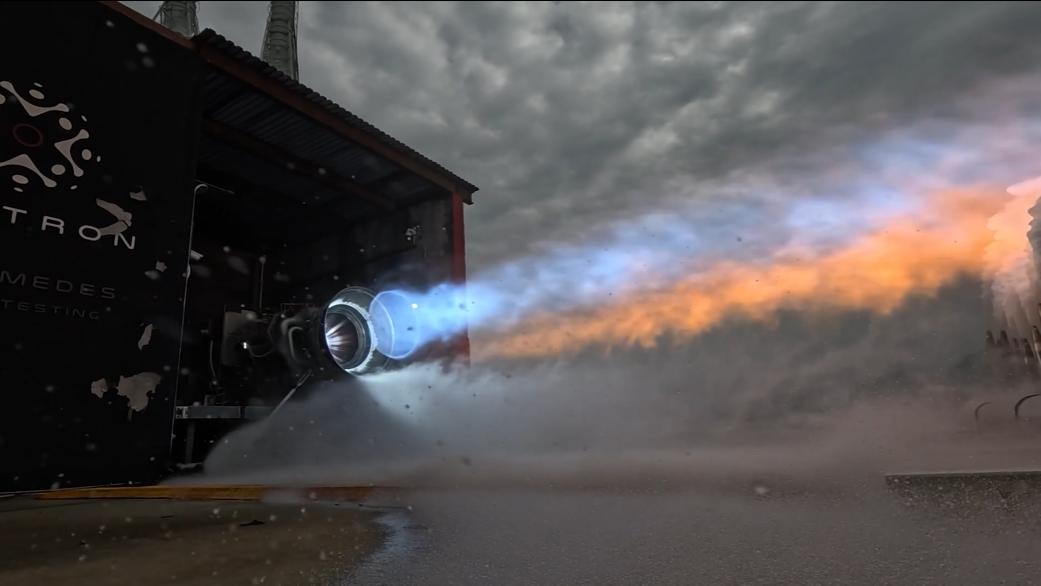
- Recently, Rocket Lab did a full-duration burn of a second-stage Archimedes engine.
- “Full-duration burn” means they fired the engine for the same amount of time it would burn during a real flight.
- This success helps them put the engine into Neutron in the coming months.
The Big Engine Test
The burn happened at Rocket Lab’s Archimedes Test Complex. That complex is located inside NASA’s Stennis Space Center in Mississippi.
- The test was made to copy real flight needs.
- It lasted just under 5.5 minutes.
- On July 13, Rocket Lab posted on social media: “What a thing of beauty” and called it a “critical preparation for Neutron’s first flight.”
Important Point: This full-duration test was a major checkpoint that simulates how the engine must perform in an actual launch, and it passed!
Meet the Neutron Rocket
Neutron is a bigger, more advanced rocket. Here’s how its engines work:
- The first stage (bottom part) has 8 Archimedes engines.
- Together, they make almost 1.5 million pounds of thrust at liftoff.
- Each engine is about as strong as a Merlin 1D engine, which powers SpaceX’s Falcon 9 rocket.
- Like Falcon 9, Neutron is partially reusable: its first stage can come back and land either at the launch site or on a droneship in the ocean.
A Silly-Sounding but Smart Design
Neutron’s top part (second stage and fairing) is different from most rockets.
- Normal rockets have a protective shell (fairing) that falls off completely in space.
- Neutron’s fairing opens like a clam shell.
- Rocket Lab named this the “Hungry Hippo” after a kids’ game.
Inside that open fairing, the second stage comes out to give the cargo a final push into orbit.
- The second stage uses one vacuum-optimized Archimedes (AVac) engine.
- Its nozzle (the bell-shaped end) is about 8 feet (2.5 meters) taller than the first-stage engines.
- In space’s vacuum, it makes 1.2 times the thrust of the first-stage engines.
Why the Test Used a Shorter Skirt
For the recent test on the ground, Rocket Lab put a shorter “sea-level variant skirt” on the AVac.
- On Earth, the full-length nozzle could have unstable airflow (“flow separation and instability”).
- The short skirt let engineers study how the engine will act with the full nozzle in space.
- They called these short parts “stub skirts” to help prove their math and analysis.
When Will Neutron Fly?
Rocket Lab first wanted Neutron’s first flight in late 2025.
- At the end of last year, they moved the date to the first half of 2026 because the rocket wasn’t ready.
- In January, a main fuel tank ruptured during a pressure test at their Virginia facility, causing another delay.
- Even with setbacks, CEO Peter Beck says the team cares about reaching orbit safely when ready, not hitting a random deadline.
Important Point: Neutron is now expected to debut in the first half of 2026, with safety and readiness prioritized over speed.
Summary
Rocket Lab successfully tested its Archimedes second-stage engine for a full 5.5 minutes in Mississippi. This engine will help power the reusable Neutron rocket, which uses a clever “Hungry Hippo” fairing and a taller vacuum engine. After some delays, Neutron’s first flight is planned for early 2026, with the team focused on doing it right.
FAQ
What is the Archimedes engine?
It is the new rocket engine built by Rocket Lab to power its Neutron launch vehicle.
What makes Neutron different from regular rockets?
Its protective shell opens like a clam (the “Hungry Hippo”), and its upper engine is extra tall for space conditions.
Why did the ground test use a shorter engine skirt?
Because the full nozzle could act unstable on Earth, so a stub skirt helped engineers learn how it will work in space.
When is Neutron’s first flight?
Rocket Lab now targets the first half of 2026.
Is Neutron reusable?
Partly—its first stage can return and land, similar to SpaceX’s Falcon 9.
 1
1