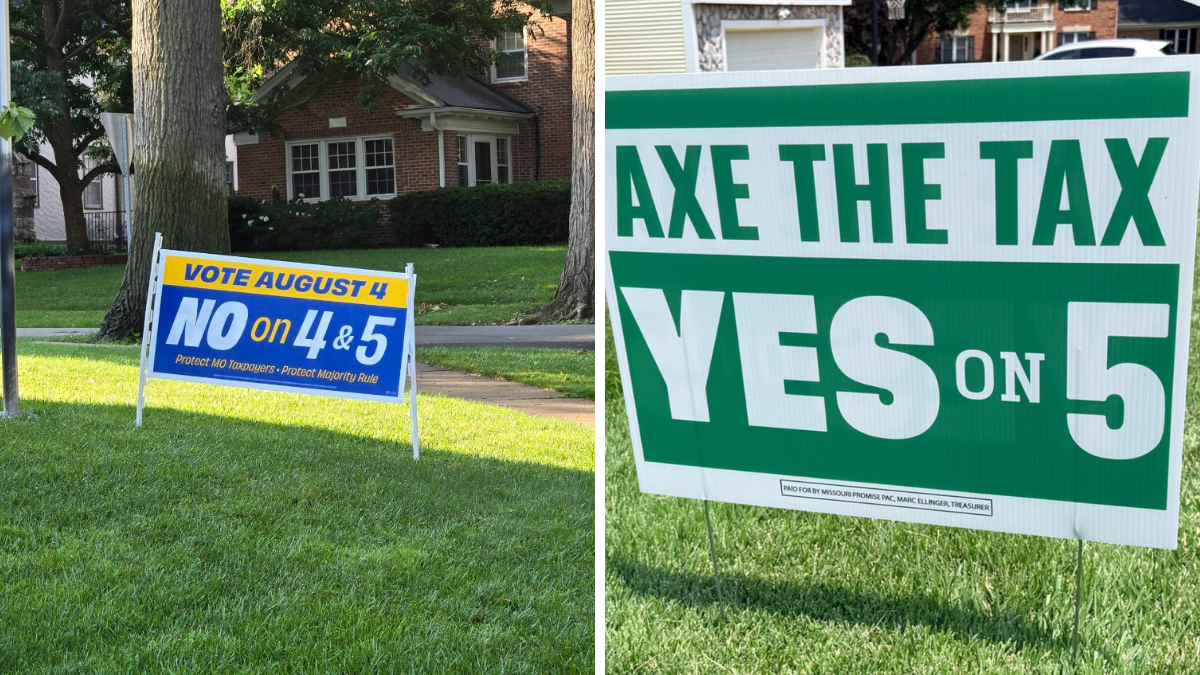
Amendment 5 Ads Exposed: What They Aren’t Telling You
Missouri Ballot Measures 2026: What You Need to Know About Amendment 5 and the $26.7 Million Ad War
Quick Takeaway: This year, Missouri voters are being bombarded with ads about ballot measures (not candidates). Over $26.7 million has been spent trying to sway your vote—mostly on Amendment 5, a proposal that would fundamentally change how Missouri collects taxes.
What Are We Voting On?
Missouri has two constitutional amendments getting the most attention this primary season:
Amendment 4: Changing How Citizen Initiatives Pass
- What it does: Requires a citizen-led ballot measure to win in all eight congressional districts instead of just a simple statewide majority.
- Important: This does not apply to measures put on the ballot by legislators—those still only need a statewide majority.
Amendment 5: The Big Tax Swap (The Main Event)
Placed on the ballot via HB 173, Amendment 5 would:
- Direct lawmakers to pass laws eliminating the state income tax (currently 4.7% on income over $9,191).
- Give lawmakers power for 5 years to raise the state sales tax rate and/or expand what gets taxed (like services) without asking voters.
- Require that any new sales tax revenue be matched by income/property tax cuts.
Key Context: Right now, most services are NOT taxed (healthcare, childcare, rent, etc.). Lawmakers must get voter approval for sales tax changes. Amendment 5 would pause those rules for five years.
The Ad War: Two Very Different Stories
Pro-Amendment 5: "Missouri Promise PAC"
- Spent: $6.4 million (as of July 24)
- Treasurer: Marc Ellinger, Jefferson City lawyer involved in GOP tax campaigns
- Main Ad: Features a talking mule ("Mule") claiming:
- "It ain’t fair you pay all those taxes while big corporations pay almost nothing."
- "Dollar for dollar, that’s income and property taxes cut by law."
- "Every dollar brought in must go towards cutting taxes."
What the Ad Doesn’t Say
| Claim | Reality Check |
|---|---|
| Corporations pay "almost nothing" | Corporate tax is 4% flat rate (vs. 4.7% top income rate). Amendment 5 doesn’t change corporate tax. |
| "Income and property taxes cut by law" | Lawmakers must pass future laws to cut taxes using "triggers" based on revenue growth. Property tax cuts are limited because schools (57.5% funded by property taxes) cannot be harmed. |
| "Every dollar brought in must go to tax cuts" | Dollars come from expanding sales tax base (taxing currently exempt services) and/or raising the sales tax rate. |
The Math Problem
- Income tax brings in ~$7.75 billion/year.
- Current 3% general sales tax covers $100B of economic activity → $3.2B revenue.
- To replace income tax only by expanding the base, lawmakers’d need to find $225B in new taxable transactions.
- Missouri’s total economy is $350B/year.
- Missouri Budget Project estimates: If base isn’t fully expanded, state sales tax could hit 11.925% (16–20% with local taxes). If fully expanded, ~6%.
Anti-Amendment 5: Four Coordinated PACs
Lead group: Missourians for Fair Taxation (backed by Missouri Realtors, $2.42M spent)
- Main Ad: Musical chairs game → only politicians get seats → "Up to 80% pay more, seniors and families hurt."
- Sources: Missouri Budget Project (using Institute on Taxation & Economic Policy data).
Key Claims vs. Reality
| Claim | Reality Check |
|---|---|
| "80% pay more, seniors/families hurt" | Seniors, working families, active military already pay little/no income tax → get minimal benefit from income tax cut, but would pay new sales taxes on services. |
| "New taxes on doctor visits, childcare, rent" | Amendment 5 lets lawmakers tax any service. Gov. Kehoe says he wants exemptions for healthcare, ag, real estate—but no language makes that binding. |
| "Rate could exceed 20%" | Combined state + local rate if base isn’t expanded (Missouri Budget Project high-end projection). |
| "Eliminates your constitutional protections, including right to vote on new taxes" | Does not eliminate the 2016 freeze (no new sales taxes on services untaxed before 2016) or Hancock Amendment (revenue limits). But suspends them for 5 years—legislature can pass taxes that would otherwise need voter approval. |
Important Point: "Suspended" vs. "eliminated" may sound different, but opponents argue: "I wouldn’t trust them for five minutes with that kind of authority." — Scott Charton, Realtors’ No on 5 campaign
Why Are the Ads So Confusing? (The Regulation Problem)
TV & Radio Ads (Broadcast)
- FCC requires: Sponsor ID + payment details in station’s political file.
- Stations CAN reject/ censor third-party ads—but almost never do.
Digital Ads (Social Media, Websites, Search)
- NO FEDERAL LAWS exist.
- Only 6 states have rules for digital political ads.
- Platforms set their own rules:
- Meta (FB/IG): Authorization + "paid for by" + AI disclosure.
- Google: Similar verification.
- X (Twitter): Bans false voting info, intimidation, election distrust.
- Enforcement is weak: Institute for Strategic Dialogue found platforms often fail to enforce their own policies.
Why This Matters
- No truth-in-advertising law for ballot issues.
- Campaigns use emotional shortcuts (musical chairs, talking mules) because detailed arguments get lost.
- Missouri voters split tickets (vote differently on issues vs. candidates) → ad spending matters MORE for ballot measures than candidates.
- No blackout period before election → expect more ads until August 4 primary.
Summary: What You Need to Decide
| If You Vote YES on Amendment 5 | If You Vote NO on Amendment 5 |
|---|---|
| You want to phase out income tax entirely. | You want to keep the income tax (progressive: higher earners pay more). |
| You trust lawmakers to replace lost revenue by broadening sales tax (taxing services) and/or raising the rate—without voter approval for 5 years. | You worry sales taxes hit low-income folks harder (they spend more of income on necessities). |
| You believe tax triggers will force cuts and schools will be protected. | You fear property tax cuts will be limited (schools need funding) and local governments will struggle. |
| You think economic growth will offset the shift. | You don’t trust temporary suspension of voter-approval rules (Hancock Amendment, 2016 freeze). |
FAQ: Your Top Questions Answered
1. Does Amendment 5 eliminate the income tax immediately?
No. It directs lawmakers to pass future laws with the goal of eliminating it, using "triggers" tied to revenue growth. This has been done before (SB 3 in 2022 cut the rate to 4.7%).
2. Will my property taxes go down?
Maybe, but limited. The law says local governments must adjust rates if the state expands the sales tax base—but school funding cannot be harmed. Since schools get 57.5% of revenue from property taxes (70% in KC), there’s little room to cut.
3. What services would be taxed?
We don’t know. The amendment doesn’t list them. Currently untaxed services include: healthcare, childcare, rent, legal services, haircuts, car repairs, etc. Lawmakers would decide. Gov. Kehoe supports exemptions for healthcare, ag, real estate—but nothing in the amendment requires it.
4. Is it true the sales tax could hit 20%?
That’s a high-end projection (Missouri Budget Project) for combined state + local rates if the tax base isn’t expanded much. If the base is fully expanded (taxing almost everything), the state rate might only rise to ~6%. Local rates vary.
5. Why is so much money being spent on this?
Because ballot measure ads work. Missouri voters are less partisan on issues than candidates, so ads sway undecided voters more. Plus, no strict truth-in-advertising rules exist—so campaigns spend heavily on emotional messaging.
Final Thought: Amendment 5 is a framework, not a finished tax plan. A YES vote gives lawmakers a 5-year window to rewrite Missouri’s tax code—shifting from income to sales taxes—without asking you first. A NO vote keeps the current system: income tax stays, sales tax changes need your vote.
Election Day: August 4, 2026 — Make sure you’re registered and ready to decide.