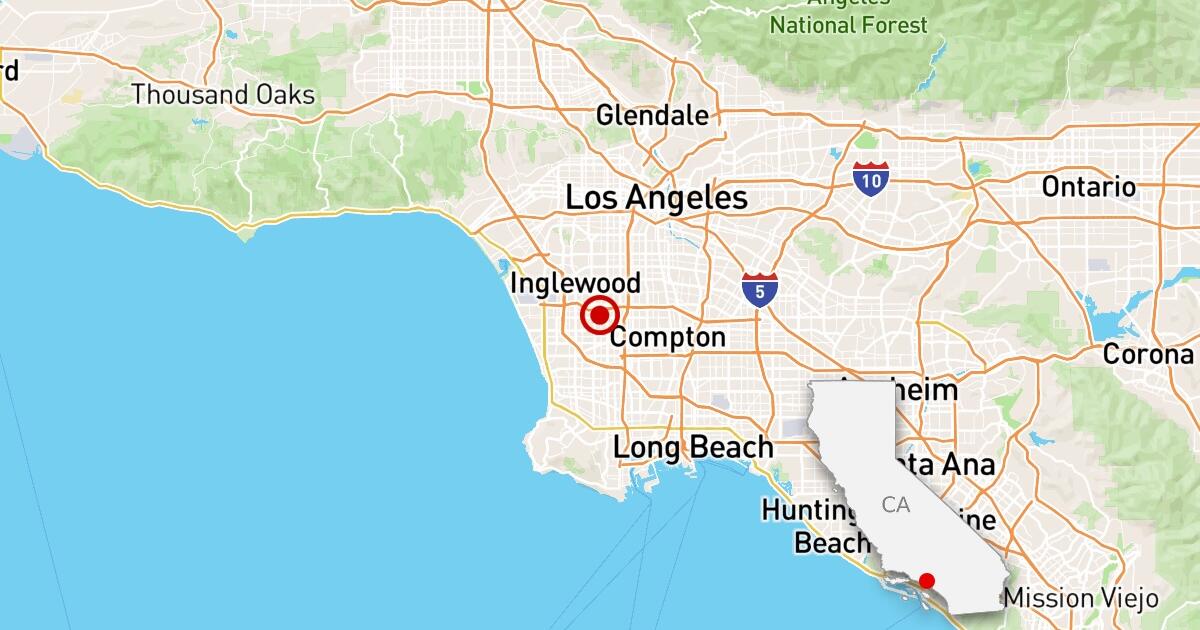
Tiny 2.6 Quake Jolts Massive Swath of LA: “Felt Like a Truck Hit”
Small Earthquake Rattles Hawthorne Area: A Simple Guide to What Happened
What Happened?
On Sunday evening, the ground gave a little shake in the Hawthorne area of Southern California. It wasn’t a big, scary earthquake—just a small one that some people nearby might have felt as a light bump or vibration.
Key Details at a Glance
Here are the basic facts about the earthquake, straight from the experts at the U.S. Geological Survey (USGS):
- Magnitude: 2.6 (This is considered a minor earthquake)
- Time: 8:30 p.m. on Sunday
- Location: Centered in Hawthorne
- Nearby Cities: Less than a mile from Gardena, Inglewood, and Westmont
- Depth: 6.5 miles underground (that’s pretty deep, which usually means less shaking at the surface)
Important Point: A magnitude 2.6 earthquake is very small. Most people sleep right through them! They rarely cause any damage.
What Is "Quakebot"? (The Robot Reporter)
You might be wondering how this news got written so fast. The answer is Quakebot—a computer program (a "bot") created by the Los Angeles Times.
- Monitors: It watches the USGS earthquake feed 24/7.
- Detects: As soon as the USGS reports a quake, Quakebot grabs the data (magnitude, location, time, depth).
- Writes: It automatically writes a basic news story using a template.
- Reviews: A real human editor at the Times reads it quickly to make sure it’s accurate.
- Publishes: The story goes live on the website within minutes.
This helps people get the facts immediately after the ground shakes.
How Can You Help? Report What You Felt
Even if the shaking was tiny, your experience helps scientists understand earthquakes better. You can be a "citizen scientist" in three easy steps:
- Go to the USGS "Did You Feel It?" page: https://earthquake.usgs.gov/earthquakes/eventpage/ci40665434/tellus
- Fill in the form: Enter your zip code, what you were doing (sleeping, sitting, walking), and what you noticed (did objects rattle? did you feel dizzy?).
- Submit: Click send. Your anonymous report gets added to a map that shows how far the shaking traveled.
Get Ready for the "Big One" (Just in Case)
Southern California is earthquake country. While this 2.6 was a tiny reminder, it’s a great nudge to get prepared for a larger quake. The LA Times offers a free guide to help you get ready in six weeks.
Sign up for the "Unshaken" Newsletter: https://www.latimes.com/newsletters/sign-up-for-unshaken-and-get-earthquake-ready-in-six-weeks
Basic starter kit checklist:
- [ ] Water: 1 gallon per person per day (aim for 3 days minimum)
- [ ] Food: Non-perishable snacks/meals (canned goods, energy bars)
- [ ] Flashlight & Batteries: (Phone flashlights drain batteries fast!)
- [ ] First Aid Kit
- [ ] Whistle: To signal for help if trapped
- [ ] Cash: Small bills (ATMs/card readers won’t work without power)
- [ ] Plan: Know where to meet family if separated and phones are down.
Quick Summary
- A minor magnitude 2.6 earthquake hit Hawthorne at 8:30 p.m. Sunday.
- It was centered 6.5 miles deep, very close to Gardena, Inglewood, and Westmont.
- The story was written by Quakebot (an automated system) and checked by a human editor.
- You can report if you felt it to help science.
- Now is the perfect time to start or check your earthquake preparedness kit.
Frequently Asked Questions (FAQ)
1. Is a magnitude 2.6 earthquake dangerous?
Almost never. Magnitudes below 3.0 are considered "micro" or "minor" earthquakes. They are usually felt only by people very close to the epicenter (the spot on the ground above the quake) and cause zero damage.
2. Why was this earthquake 6.5 miles deep? Is that deep?
Yes, that is moderately deep. Earthquakes can happen just a few miles down or over 10 miles down. Deeper quakes often feel like a sharp "jolt" rather than a rolling motion, and the shaking is spread over a wider area but feels weaker at the surface.
3. What is the USGS?
The United States Geological Survey is the federal science agency responsible for monitoring earthquakes, volcanoes, landslides, and water resources in the U.S. They are the official source for earthquake data.
4. Can Quakebot make mistakes?
Since it pulls data directly from the USGS computers, the numbers (magnitude, location, time) are usually exactly right. However, sometimes the USGS updates the magnitude later (e.g., revising 2.6 to 2.5). The LA Times editor checks the story before publishing, and they update the article if the USGS changes the data.
5. Do I really need an earthquake kit if I live in an apartment?
Yes. In a major earthquake, water mains break, power goes out for days, and grocery stores close. You are responsible for your own survival for at least 72 hours (3 days) before help arrives. A kit fits in a closet or under a bed—it’s cheap insurance.