
How France Exploded For Two Golds On Day 4 Of 2026 Euro Jr Champs
2026 European Junior Swimming Championships
A Quick Intro: What Is This Event?
Imagine a big swimming competition in Europe where only young athletes (called "juniors," meaning they are not adults yet) race in a pool. Countries send their best young swimmers to win medals for their nation. In 2026, this event is happening, and we are now a few days into the races.
France Got Called Out—Then Fought Back!
A writer for a swimming news site recently pointed out (in this earlier article) that France was winning fewer medals than they did at last year’s European Junior Championships.
Well, it seems France listened! On day four of the meet (that’s the fourth day of racing), the country suddenly won two gold medals in one evening.
Important Point: Sometimes a little friendly criticism is all it takes—France responded with two golds right after being called out for being behind their previous year’s medal count!
How France Won Those Golds
Here’s what happened in simple steps:
- Nathan Muratory, a swimmer who has promised to join the University of Michigan’s swim team in the USA (called a "commit"), raced in the boys’ 200m backstroke.
- "200m backstroke" means swimming 200 meters (about 4 lengths of an Olympic pool) while floating on your back.
- He finished in 1:55.88—that’s his lifetime best, meaning the fastest he has ever swum that race!
- This gave France its first gold medal of the meet, which they really needed.
- Right after that, in the very next race, his teammate Jeanne Lechevalier won the girls’ 200m backstroke.
- She also got a gold medal for France.
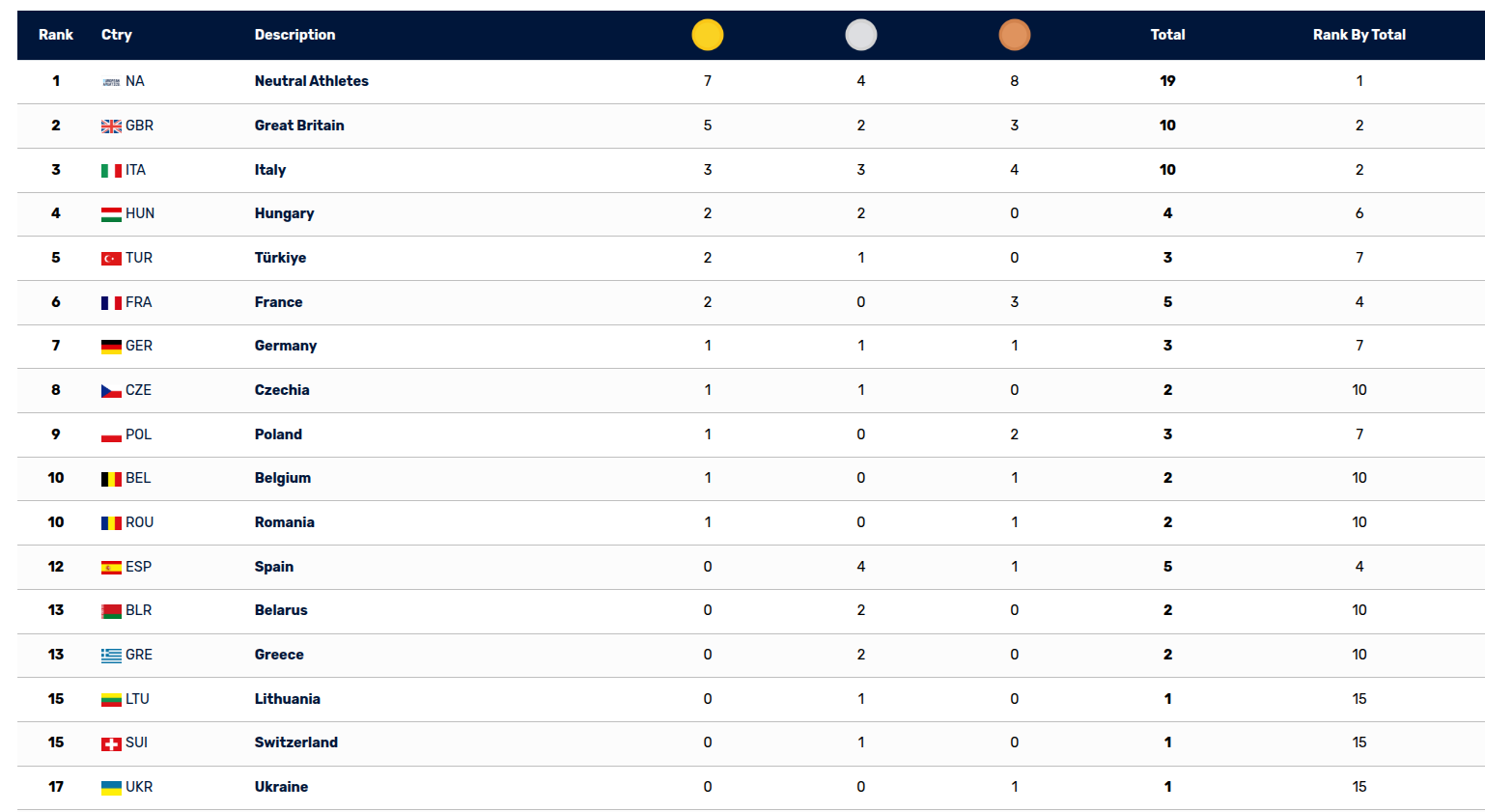
Because of these two wins, France jumped up to 6th place in the overall swimming medal table, even though we are already more than halfway through the competition.
The Big Scoreboard (Medal Table)
Let’s look at which countries have the most medals so far. Think of it like a leaderboard in a video game:
- Neutral Athletes (also known as Russia): Sitting in 1st place with 19 pieces of hardware (medals) total, and 7 of those are gold. (They are called "Neutral Athletes" because they compete without showing their country’s flag, but they are from Russia.)
- Great Britain: In 2nd place with 10 medals: 5 gold, 2 silver, and 3 bronze.
- Italy: Holding 3rd place with 10 medals total, including 3 gold.
- France: Now up to 6th place thanks to their two new golds.
What Happens Next?
There are still two more days of swimming left. That means the overall winner’s trophy—called the European Junior Championships Trophy—is still anyone’s guess. Countries can still climb the ranks by winning more races.
Key Reminder: The trophy is not decided yet! Two days remain, so anything can happen.
Summary
To wrap it up:
- The 2026 European Junior Swimming Championships are underway.
- France was behind its previous year’s medal haul, but on day four they won two golds: Nathan Muratory (boys’ 200m backstroke, time 1:55.88 lifetime best, University of Michigan commit) and Jeanne Lechevalier (girls’ 200m backstroke).
- France moved to 6th in the overall medal table more than halfway through the meet.
- Neutral Athletes (Russia) lead with 19 medals (7 gold); Great Britain (10 medals: 5G,2S,3B) and Italy (10 medals, 3 gold) follow.
- With two days left, the top trophy is still up for grabs.
FAQ
Q1: What does “junior” mean in this swimming championship?
A: It means the competitors are young athletes, usually teenagers, not full adults. It’s a showcase for the next generation of swimmers.
Q2: What is a “lifetime best” in swimming?
A: It’s the fastest time a swimmer has ever recorded in a specific race. For Nathan, 1:55.88 was the quickest he’s ever done the 200m backstroke.
Q3: Who are the “Neutral Athletes” and why are they called that?
A: They are swimmers from Russia who are competing without their national flag or anthem, often due to international sports rules. They are listed as “Neutral Athletes” on the scoreboard.
Q4: What is the European Junior Championships Trophy?
A: It’s a big prize given to the country that finishes with the best overall performance (most medals) by the end of the meet.
Q5: What does “commit” mean when talking about a university?
A: In sports, when a young athlete “commits” to a university (like the University of Michigan), it means they have promised to join that school’s team in the future.