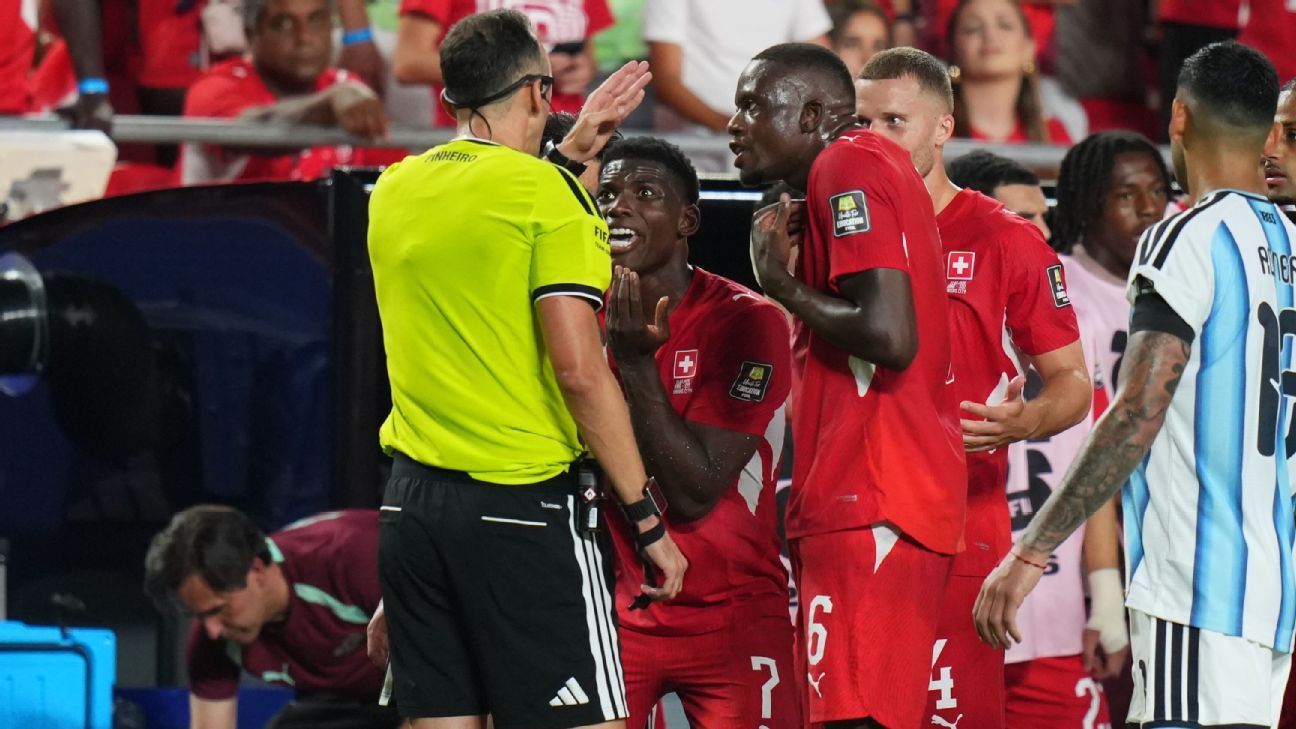
Why Switzerland is FURIOUS: Embolo’s VAR red card for diving
Switzerland’s World Cup Heartbreak: The Red Card That Changed Everything
Originally reported on July 12, 2026, from Kansas City, Mo.
What Happened in the Big Match?
Imagine the World Cup (the biggest soccer tournament on the planet) quarterfinal (a make-or-break game to see who reaches the top 4). Switzerland was playing against Argentina. The game was super close, tied 1-1, and went into extra time (bonus playing minutes because the score was still tied after regular time). Eventually, Argentina won 3-1. But the story everyone is talking about isn’t just the score—it’s a confusing rule and a surprising red card.
The Controversial Call: Embolo’s Red Card
Here is the step-by-step, playground-style breakdown of what happened in the second half:
- Breel Embolo (a Swiss player whose main job is to score goals, called a "forward") fell over during a play.
- Leandro Paredes (an Argentine player) touched him, and the referee (named João Pinheiro) initially gave Paredes a warning card (called a "yellow card") for tripping.
- The Video Assistant Referee (VAR)—think of them as replay helpers watching on TV—looked again. They saw Embolo was already falling before Paredes even touched him. This is called "simulation" (acting like you got fouled when you didn’t).
- Embolo had already gotten a yellow card earlier in the game. In soccer, if you get two yellow cards, you get a red card and are sent off (kicked out of the match).
- Because of the video review, Embolo got his second yellow card, it turned into a red, and he had to leave. Switzerland had to play the rest of the game with only 10 players instead of 11.
Important Point: This was a massive momentum swing! Just moments before, Switzerland’s Dan Ndoye had scored to tie the game 1-1. The Swiss team was feeling confident and playing great, but suddenly they were down a player.
Why Was Switzerland So Upset?
The Swiss team and their coach, Murat Yakin, were absolutely furious. Here is why:
- Nico Elvedi (a Swiss defender) said: "I just don’t understand how VAR can make that kind of decision."
- Coach Yakin explained that after the tie, they were "dominant" and "controlled the game." He wanted to put fresh, fast attacking players on the field to keep the pressure on.
- Yakin said: "The red card, we are punished because of a rule that is, to me, absolutely incomprehensible. Of course it hurts enormously that we were eliminated in this way. We didn’t deserve that today."
- He also felt the referee shouldn’t have given Paredes a yellow card in the first place, calling it a "harmless foul—or if it was even a foul at all."
- Yakin added: "For a situation where beforehand there should have been yellow cards several times, he gave a yellow card… They protect their referee over a rule that destroyed our game today… First of all, for me there was not a single reason to give the Argentine player a yellow card. He simply should have let play continue. He corrected his own mistake against us, and well, afterward you could see that we were playing with one fewer man."
The Special Rule That Made It Worse
This situation used a specific rule called the "mistaken identity" protocol.
- In simple terms: This rule lets the video refs step in and fix things if the wrong player is shown a warning card (yellow or red).
- This was actually the second time in World Cup history that a yellow card has been overturned using this exact protocol.
- Because the referee originally gave Paredes a yellow card for the trip, the VAR was allowed to look at it. When they saw Embolo faked it, they gave the second yellow to Embolo instead.
- Had Paredes not been booked at all, the video refs would not have been allowed to intervene under this rule.
Key Takeaway: The coach felt the system "protected their referee over a rule that destroyed our game today."
How Did the Players and Coach React?
The emotions were raw after the game:
- Embolo was in tears after being ordered to leave the field by referee João Pinheiro, and needed hugs from his teammates on the sideline.
- Coach Yakin defended him, saying: "You can imagine how Breel feels… He had been attacked several times beforehand, and he had two or three good phases in the attacking game. But afterward he could no longer help the team. To blame him now is absolutely absurd. He always works for the team, he always had good moments in our game, of course he’s devastated that he couldn’t help the team."
- Granit Xhaka (the Swiss team captain) said the red card totally changed their game. He described the locker room as "very quiet, disappointed," and said: "This decision was difficult to accept now after the game because the dressing room was very quiet, disappointed."
- Ultimately, Argentina scored two late goals in extra time (by Julián Álvarez and Lautaro Martínez) to win 3-1.
A Look at the History Books
Sadly for Embolo, he joined a very small and unwanted club:
- He is only the 4th player in the past 60 years of the World Cup to get a second yellow card for "simulation" (faking a foul).
- The other three players were:
- Luis Pérez (from Mexico, in 2006 against Portugal)
- Asamoah Gyan (from Ghana, in 2006 against Brazil)
- Francesco Totti (from Italy, in 2002 against South Korea)
Summary
In a nail-biting World Cup quarterfinal, Switzerland was tied 1-1 with Argentina and playing amazingly well. But a video review (VAR) changed everything: Swiss striker Breel Embolo was given a red card for faking a foul, forcing his team to play with one less player. The Swiss coach and players called the ruling "incomprehensible" and felt the "mistaken identity" rule unfairly destroyed their chance to win. Argentina went on to score two more goals in extra time, winning 3-1 and breaking Swiss hearts.
FAQ
1. What is a red card, and why did Embolo get one?
A red card means a player is kicked out of the game. Embolo got one because he already had a yellow card (a warning), and the video review gave him a second yellow for pretending to be fouled (simulation). Two yellows equal one red.
2. What does VAR mean?
VAR stands for Video Assistant Referee. It’s a team of officials who watch the game on screens and help the main referee fix clear mistakes using video replays.
3. What is the "mistaken identity" rule in soccer?
It’s a rule that lets VAR step in if the referee shows a yellow or red card to the wrong player. In this case, the ref first carded the Argentine player, which opened the door for VAR to review and card Embolo instead.
4. Did Switzerland have a chance to win before the red card?
Yes! They had just tied the game 1-1 and their coach said they were "dominant" and controlling the match. Losing a player made it much harder, and they eventually lost 3-1 in extra time.
5. Has this happened to other famous players?
Yes, Embolo is the fourth player in 60 years to get a second yellow for simulation at a World Cup, joining Mexico’s Luis Pérez, Ghana’s Asamoah Gyan, and Italy’s Francesco Totti.
ESPN’s Bill Connelly and The Associated Press contributed to this report.