Earth in Crosshairs: M6.9 Solar Flare Could Ignite Auroras
Sun Unleashes Powerful Solar Flare: What It Means for Earth
The Big News: A Major Solar Burst
On August 25, the Sun let out a big "burp" — a powerful M6.9 solar flare from a busy sunspot called Region 4513. This sunspot has been very active lately, firing off five M-class flares in just 24 hours!
The flare peaked at 6:00 a.m. EDT (10:00 GMT), according to SpaceWeatherLive.
What Is a Solar Flare? (ELI5 Explanation)
Think of the Sun like a giant pot of boiling soup. Sometimes, bubbles of super-hot, magnetic plasma burst outward. That burst is a solar flare — a sudden flash of high-energy light and radiation.
Solar Flare Strength Scale
Flares are ranked like earthquakes — each letter is 10 times stronger than the one before:
| Class | Strength | Common? |
|---|---|---|
| A | Tiny | Very common |
| B | Small | Common |
| C | Medium | Fairly common |
| M | Large | Less common |
| X | Monster | Rare |
M-class is the second-strongest category, just below the most intense X-class flares.
What Happened Right After the Flare?
Radio Blackout (R2 Level)
The flare’s intense X-rays and UV radiation hit Earth’s dayside atmosphere, causing a moderate (R2) high-frequency radio blackout.
Areas affected:
- Africa
- Europe
- The Arctic
Why does this happen? The radiation super-charges the ionosphere (a layer of Earth’s upper atmosphere), which absorbs or blocks high-frequency radio waves used by aviators, mariners, and emergency services.
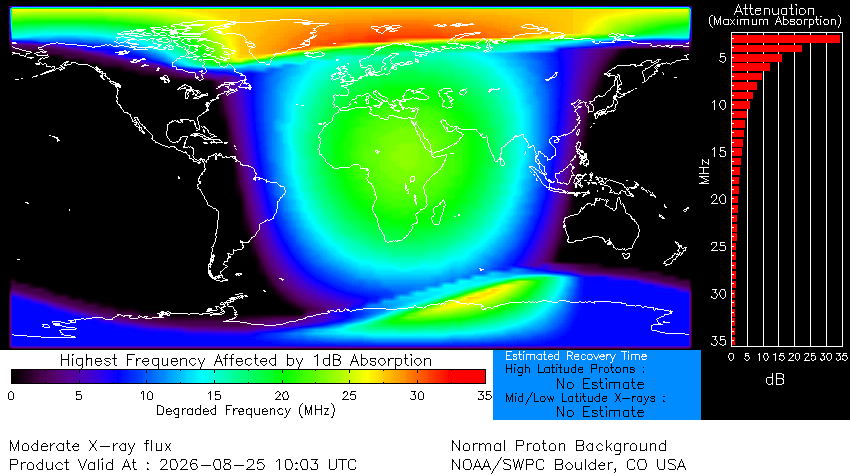
Map of radio disruptions from the M6.9 flare. (Image credit: NOAA Space Weather Prediction Center)
The Next Act: A Coronal Mass Ejection (CME) Is Coming
The flare also hurled a Coronal Mass Ejection (CME) into space — a massive cloud of magnetized plasma.
What’s a CME? (ELI5)
If a solar flare is a flash of light, a CME is like a cannonball of solar material. It’s billions of tons of charged particles (plasma) and magnetic field blasted outward at high speed.
Will It Hit Earth?
Early models say: Maybe a glancing blow.
| Detail | Prediction |
|---|---|
| Expected arrival | Friday, August 28 |
| Time window | ~6–7 a.m. EDT (10:00–11:00 GMT) |
| Uncertainty | ±7 hours |
| Speed | Slow (not a fast, powerful CME) |
| Impact angle | Glancing blow (not a direct hit) |
Aurora chaser Jure Atanackov (using NASA’s M2M WSA-ENLIL+Cone model): "Slow, not expecting much from this one."
Plot Twist: A Solar Wind Stream Is Also Coming!
Just as the CME might arrive, another player enters the scene:
High-Speed Solar Wind from a Coronal Hole
- Source: A positive-polarity coronal hole (a dark, cooler region on the Sun where magnetic field lines open into space)
- Starts influencing Earth: August 27
- Forecast (from SIDC): Unsettled to active geomagnetic conditions, with a chance of minor storm levels (G1)
Why This Combo Matters for Aurora Chasers
Two space weather events arriving together = potential team-up!
| Scenario | Result |
|---|---|
| CME arrives during fast solar wind | Enhanced geomagnetic activity → Brighter, wider auroras |
| CME arrives before/after wind stream | Weaker or separate effects |
Key factor: The magnetic orientation of the CME when it arrives. If its magnetic field points southward (opposite Earth’s northward field), they connect like magnets → stronger geomagnetic storm → better auroras.
Important Points to Remember
KEY TAKEAWAYS
- No danger to people on the ground — Earth’s atmosphere and magnetic field protect us.
- Radio comms & GPS may briefly degrade on sunlit side (already happened).
- Power grids & satellites are monitored; operators take precautions if needed.
- Aurora watchers (especially at high latitudes) should keep an eye on forecasts for Aug 27–29.
- Predictions have uncertainty — timing and impact can change. Check updates!
What Happens Next? (Step-by-Step)
- Aug 25 (Today) — M6.9 flare + CME launch + radio blackout Done
- Aug 27 (Wed) — Fast solar wind stream begins buffeting Earth’s magnetic field
- Aug 28 (Fri) — CME possible glancing arrival (6–7 a.m. EDT ±7 hrs)
- Aug 27–29 — Combined effects could spark geomagnetic storms & auroras
- Ongoing — Scientists refine models; we update forecasts
Summary
On August 25, a hyperactive sunspot (AR 4513) fired an M6.9 solar flare — the second-strongest class — causing radio blackouts over Africa, Europe, and the Arctic. The flare also launched a CME that might give Earth a glancing blow on August 28. Meanwhile, a fast solar wind stream arrives August 27. If they overlap and the CME’s magnetic field points south, auroras could light up skies farther south than usual. The CME is slow and weak, so don’t expect a major storm — but space weather is full of surprises. Stay tuned!
FAQ
Is this solar flare dangerous to me or my family?
No. Earth’s atmosphere blocks the harmful radiation. You won’t feel it, and it poses no health risk on the ground.
Will my phone, internet, or power go out?
Very unlikely. This event is too weak to cause widespread outages. Power grid operators and satellite teams monitor space weather and take precautions if needed. Brief GPS glitches or radio static are possible but temporary.
Can I see the Northern Lights (aurora) from my backyard?
Maybe — if you live at high latitudes (northern US, Canada, UK, Scandinavia, etc.). Check the NOAA Space Weather Prediction Center or apps like My Aurora Forecast for real-time alerts on Aug 27–29. Dark skies + clear weather + geomagnetic activity = best chance.
What’s the difference between a solar flare and a CME?
- Solar flare = Intense burst of light/radiation (travels at light speed, arrives in ~8 minutes).
- CME = Giant cloud of magnetized particles (travels slower, takes 1–3 days to reach Earth).
They often happen together but are different things.
Why do scientists care about the CME’s magnetic direction?
Earth’s magnetic field points north. If the CME’s field points south, they connect (reconnection), letting energy pour into our magnetosphere → geomagnetic storm → auroras. If it points north, they repel → minimal impact.
Stay curious, keep looking up, and check back for updates as Friday approaches!