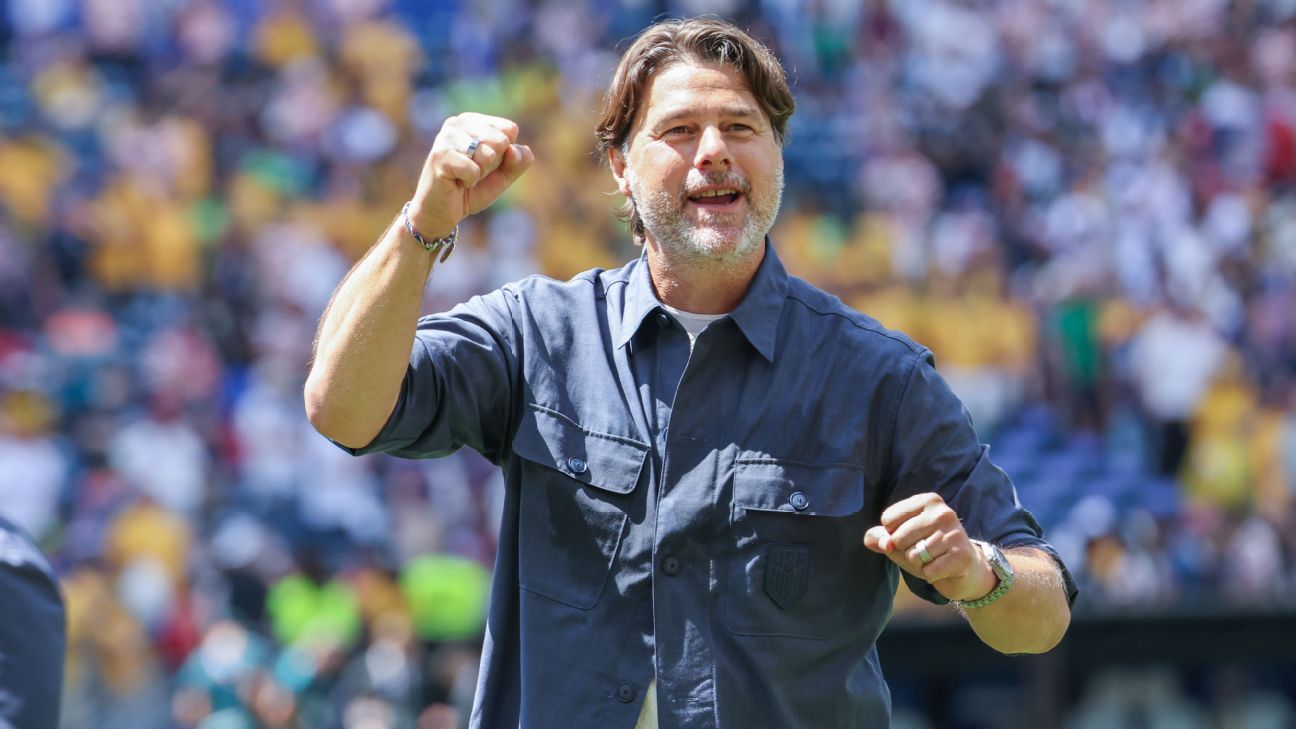
Mauricio Pochettino Stays: What His New Contract Means for U.S. Soccer
Published: August 3, 2026
By: Bill Connelly, Cesar Hernandez, Lizzy Becherano, and Jeff Carlisle (ESPN Staff Writers)
The Big News in Simple Terms
KEY ANNOUNCEMENT: Mauricio Pochettino has signed a new four-year contract to remain the head coach of the U.S. Men’s National Team (USMNT) through the 2030 FIFA World Cup.
Despite rumors linking him to AC Milan this past spring and a disappointing Round of 16 loss to Belgium at the 2026 World Cup, Pochettino is staying put. ESPN’s soccer experts broke down what this means for American soccer.
What Pochettino Got Right (His First Two Years)
Our four experts agree: Pochettino changed the culture of the team for the better. Here’s how:
1. Accountability Became the Standard
- Jeff Carlisle says the biggest change was accountability.
- Before Pochettino, players felt too comfortable — spots on the team weren’t truly earned.
- Now? No one’s spot is safe. Playing time must be earned every single day.
- This "buy-in" was visible during the World Cup.
2. A Fun, Cohesive Playing Style
- Bill Connelly notes that despite the core starters barely playing together in the previous four years, Pochettino got them playing cohesive, aggressive soccer.
- The style maximized the team’s athleticism advantage.
- He also quickly developed young talent like Alex Freeman.
- Reminded Connelly of Pochettino’s exciting Tottenham Hotspur teams — but without the exhaustion of a full club season.
3. Culture Shift: "Everything Matters"
- Cesar Hernandez credits Pochettino for transforming the squad’s identity and culture.
- Lizzy Becherano shares a quote from veteran defender Tim Ream (Charlotte FC):
"Everything matters, right? And I think that’s more what [Pochettino’s] desire and his meaning is, is that everything counts… Everything matters every single day from the minute you wake up until you go to sleep."
- Training sessions became intense. Pochettino brought the passion he grew up with in Argentina to the U.S. setup.
Where the U.S. Must Improve (Next Four Years)
Staying good isn’t enough — the team needs to fix clear weaknesses:
1. Stop Worrying About Uncontrollables
- Carlisle warns Pochettino sometimes complained about things he can’t control:
- Crowds at the 2025 Gold Cup where U.S. fans were outnumbered.
- Comments after losses to Belgium and Portugal that "the U.S. didn’t have players in the top 100 in the world."
- Why it matters: This sounds like making excuses. It doesn’t help players. World Cup qualifying will have plenty of uncomfortable moments — Pochettino must accept reality and focus on what he can control.
2. Defensive Vulnerability Against Top Teams
- Connelly points out a scary stat: Against the six highest-ranked FIFA opponents this year, the U.S. allowed 18 goals.
- Playing wide-open, aggressive soccer is fun — but good teams will rip you apart.
- The weakest position right now? Center back depth. The U.S. doesn’t have enough high-quality backup options there.
- Balance needed: The style helps avoid upsets in qualifying, but against elite teams, it leaves the defense too exposed.
3. Dual-National Recruitment (Mexican-American Talent)
- Hernandez asks: Was Pochettino good at recruiting dual-nationals?
- Mexico (El Tri) has won recent battles for Mexican-American players who could’ve played for either country.
- Examples: Brian Gutiérrez and Obed Vargas chose Mexico.
- Vargas is now a key midfielder in Europe.
- Gutiérrez is close to that level (if Chivas lets him leave).
- The U.S. needs to win more of these recruiting battles.
4. Consistency Over 90 Minutes (and Tournaments)
- Becherano loved the group stage brilliance — dominating Paraguay and Australia with organization, tactics, and passion.
- But it vanished against Belgium in the Round of 16.
- The goal for the next cycle: Maintain that high level for full tournaments, not just flashes.
Will He Leave for a European Club Job?
This is the million-dollar question. Here’s what the experts think:
| Expert |
Verdict |
Key Reasoning |
| Jeff Carlisle |
Very real threat |
4 years is a long time. World Cup qualifying + Nations League + Gold Cup = a "slog" that might bore a club coach at heart. Contract release clause details matter hugely. USSF needs a backup plan. |
| Bill Connelly |
Less real now… but not zero |
Pochettino re-signed because money was good + no clear club jobs. But 4 years is forever in soccer (look: Berhalter fired twice in last 4 years!). Poch will be 58 in 2030. Chances of leaving for a great offer > 0%. |
| Cesar Hernandez |
He’d love to return to Europe |
Obvious flirtation with European clubs. If it were up to him, he’d go back to the Premier League to prove himself. Paycheck might be the only thing keeping him. |
| Lizzy Becherano |
Committed to finishing the project |
Pochettino has said: "The Premier League is the best in the world. Of course I miss it… I would love to come back again." (BBC, Dec 2025). But she believes he intends to finish the 2030 project — which could even include a game in his native Argentina. |
IMPORTANT POINT: The contract’s release clause (the fee a club must pay to hire him) is the biggest practical barrier. If it’s too high, clubs won’t pay. But if it’s too low, Pochettino might resent missing a dream job.
Summary: What This Means for You (The Fan)
- Stability is good. The USMNT keeps a proven, world-class coach for the most important cycle ever (2030 World Cup on home soil).
- Culture is fixed. Accountability, intensity, and "everything matters" are now the baseline.
- Real work remains: Defense vs. top teams, recruiting dual-nationals, and consistency are the three pillars of the next four years.
- The "Will He Leave?" cloud hangs over everything. It’s manageable now — but US Soccer must have a Plan B.
FAQ: Your Burning Questions Answered
Why did Pochettino almost leave for AC Milan?
He’s a club coach at heart. The Premier League/Serie A grind — weekly games, daily training, total control — is what he knows and loves. International football is sporadic by comparison. The Milan links were real because a top European job opened up.
What is a "release clause" and why does it matter?
It’s a fee written into the contract that another team (like a Premier League club) must pay U.S. Soccer to hire Pochettino before his contract ends. A high clause = he stays. A low clause = he could leave easily. The exact number is usually secret.
Who are the "dual-nationals" and why does the U.S. lose them to Mexico?
Players eligible for both the U.S. and Mexico (usually Mexican-American). Mexico often wins because of cultural ties, family pressure, and recently — better on-field success/recruitment effort. Losing Vargas and Gutiérrez hurts.
Is the U.S. defense really that bad?
Against elite teams, yes. 18 goals allowed in 6 games vs. top-15 FIFA opponents is alarming. The center back position lacks depth and star power. Pochettino’s high-risk system exposes this. Fixing it is Priority #1.
What happens if Pochettino does leave in 2028 or 2029?
Chaos. But that’s why Carlisle says USSF needs a backup plan now. Ideally: identify a successor early, keep the culture, and avoid the panic-hiring that happened when Berhalter left (twice!).
Final Thought: Four years is a lifetime in soccer. Pochettino staying is a win for stability — but the real test isn’t the signature on the paper. It’s whether the U.S. can defend like champions, recruit like winners, and play like contenders for 90 minutes, every game, for four straight years. The 2030 World Cup starts now.
 1
1