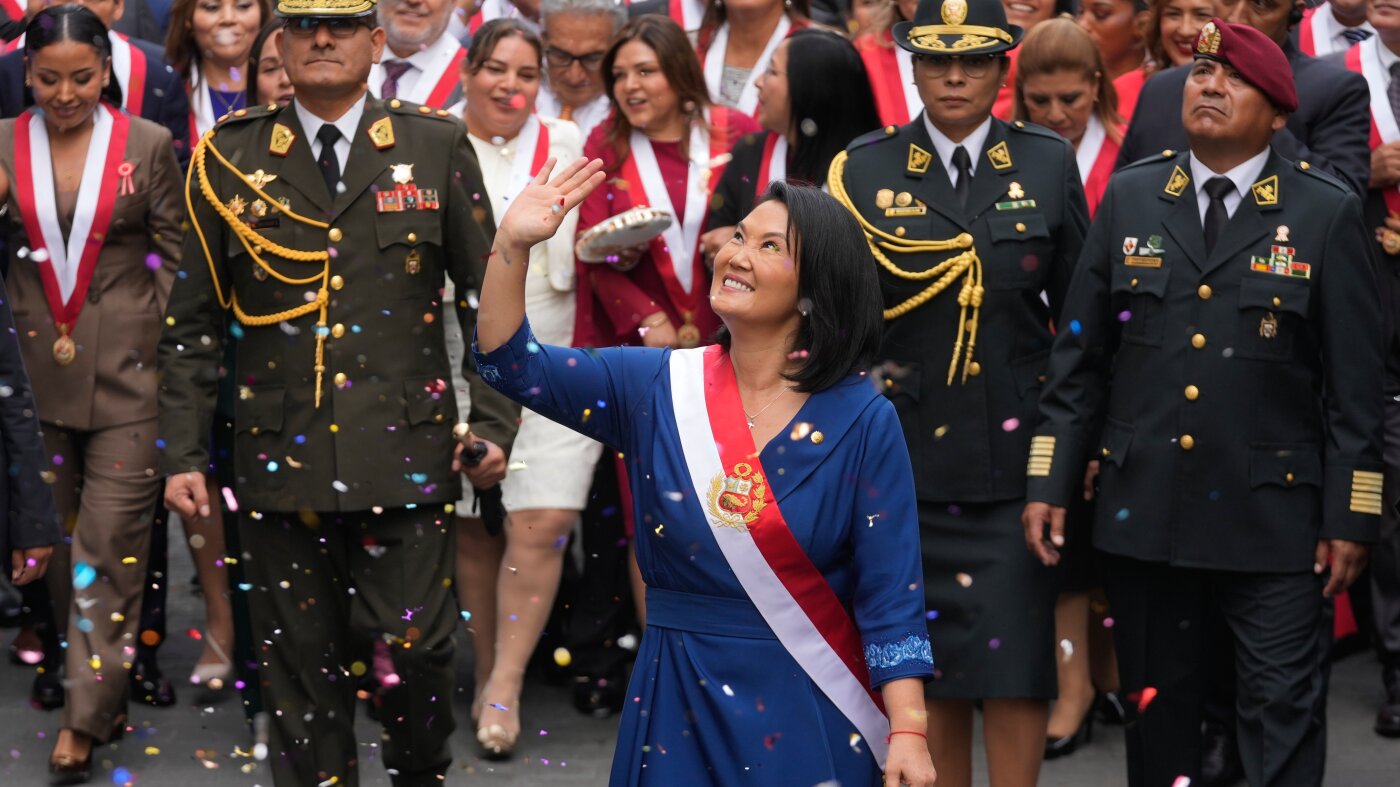
NPR: Keiko Fujimori Sworn In as Peru’s President!
Keiko Fujimori Becomes Peru’s New President: What You Need to Know
The Big News
Conservative leader Keiko Fujimori was sworn in as Peru’s president on Tuesday. She won a very close election in June, beating her opponent by fewer than 50,000 votes. At 51 years old, she becomes the country’s ninth president in just ten years—a sign of how rocky Peru’s politics have been.
Important Point: This win is part of a bigger trend in South America where conservative candidates have been winning major elections recently.
Why Peru’s Politics Have Been So Unstable
Imagine a classroom where the class president keeps quitting or getting fired, and a new one takes over almost every year. That’s basically what’s happened in Peru:
- Only 3 of the last 9 presidents were elected directly by voters.
- The others took over after their predecessors resigned or were removed by Congress during corruption scandals.
- This constant turnover makes it hard for the government to make long-term plans.
Good news for Fujimori: Her party (Popular Force) and its ally (Popular Renovation) will control half the seats in the Senate. This makes it much harder for opponents to try to remove her like they did with previous presidents.
Who Is Keiko Fujimori?
Her Political Background
- Four-time presidential candidate (she ran in 2011, 2016, 2021, and won in 2026).
- Leader of Popular Force, Peru’s largest political party.
- Daughter of Alberto Fujimori, who was president in the 1990s.
Her Father’s Complicated Legacy
| The Good | The Bad |
|---|---|
| Stabilized Peru’s economy | Government became authoritarian |
| Defeated dangerous terrorist groups | Military committed human rights abuses under his rule |
| He was imprisoned for these abuses | |
| Pardoned in December 2023, died September 2024 |
Keiko has to balance honoring her father’s economic successes while distancing herself from his authoritarian mistakes.
What She Promised to Do: Her "To-Do List"
Fujimori campaigned on fixing everyday problems for regular Peruvians. Here are her main promises:
1. Fight Crime with an "Iron Fist"
- Problem: Extortion rackets (criminals forcing businesses/people to pay for "protection") are a huge issue.
- Plan: Copy strategies from El Salvador’s President Nayib Bukele.
- Specific action: Build a mega-prison modeled after El Salvador’s notorious Cecot penitentiary.
- Court reform: Let judges hide their identities during criminal trials so gangs can’t threaten them.
2. Boost the Economy
- Make it easier for the government to partner with private companies to build infrastructure (roads, bridges, utilities).
- Raise the minimum wage by 15%.
- Peru’s economy is actually one of Latin America’s most stable (central bank interest rate below 5%, careful government spending).
3. Help Poor Communities
- Reorganize social services to fight malnutrition in rural areas.
- Prepare for El Niño—a weather pattern that warms the ocean and causes flooding on Peru’s coast.
4. Temporary Military Role
- The military will temporarily lead security operations in the worst crime-hit areas.
In her words: "My goal is not only to administer the state. My main objective is to narrow the enormous social deficit that affects millions of Peruvians."
The Opposition Is Not Happy
Laws They Want Changed
The previous Congress passed laws that critics say help criminals and corrupt politicians:
- Eliminated preventive arrests (police can’t hold suspects easily).
- Stopped prosecutors from investigating political parties for corruption using the same tools they use for criminal gangs.
- Made it harder for police to seize assets from criminal groups.
Protests & Deaths They Want Investigated
- 50 civilians died in protests (late 2022–early 2023) after former President Pedro Castillo was removed.
- Opposition demands a truth commission to investigate.
- At Fujimori’s inauguration, opposition lawmakers protested outside holding photos of the dead.
- Victims’ families don’t recognize her as president.
A Country Split in Two
Peru is deeply divided geographically and culturally:
| Supported Fujimori | Supported Roberto Sánchez (Left-wing) |
|---|---|
| Capital city (Lima) | Andean highlands |
| Pacific coast | Areas with larger Indigenous populations |
| Ally of former President Castillo |
Sánchez challenged the results, claiming voting irregularities at Peruvian consulates abroad, but election authorities rejected his complaints.
The Bigger Picture: South America Turns Right
Fujimori’s win isn’t happening in isolation. It’s part of a conservative wave across the region:
| Country | Conservative Winner |
|---|---|
| Peru | Keiko Fujimori (2026) |
| Colombia | Abelardo de la Espriella |
| Chile | José Antonio Kast |
This is a huge shift from the 2000s when left-wing leaders like:
- Hugo Chávez (Venezuela)
- Lula da Silva (Brazil)
…dominated the continent.
Why the Shift?
Conservatives have won 7 major Latin American presidential elections recently, most since January 2025 (when Donald Trump became U.S. president again). Voters are worried about:
- Crime
- Immigration
- Slow economic growth
The Challenge Ahead: Two Perus
Despite Peru’s stable macro-economy (big picture numbers), there’s a growing gap in living standards:
- Coastal areas (wealthier, more developed)
- Andean highlands (poorer, more Indigenous, left behind)
Fujimori’s biggest test will be whether she can bridge this divide while delivering on her tough-on-crime promises without repeating her father’s authoritarian mistakes.
Summary: Key Takeaways
- Keiko Fujimori is Peru’s new president after a razor-thin election win.
- Peru has had 9 presidents in 10 years—she hopes to bring stability.
- Her party controls half the Senate, protecting her from easy removal.
- Main promises: Crush crime (Bukele-style), raise wages 15%, fight rural malnutrition, prep for El Niño.
- Opposition protests: Want corrupt-friendly laws repealed, investigation into 50 protest deaths.
- Country is polarized: Coast/capital vs. Indigenous highlands.
- Part of a regional conservative wave driven by crime, immigration, and economy fears.
- Biggest challenge: Fixing the huge inequality between coastal and mountain Peru.
FAQ: Your Questions Answered
1. Why has Peru had so many presidents recently?
Presidents keep getting caught in corruption scandals or fighting with Congress. Since only 3 of the last 9 were elected, the others were essentially "backup" presidents who took over when the elected one fell.
2. Is Keiko Fujimori a dictator like her father?
Not based on her election—she won a democratic runoff. But critics worry her "iron fist" crime policies (copying Bukele) and family history could lead to authoritarian tendencies. She’ll have strong Senate support, which reduces checks on her power.
3. What is the "Cecot" prison she wants to copy?
It’s a mega-prison in El Salvador built to hold thousands of gang members. It’s controversial—human rights groups criticize harsh conditions, but it’s popular with Salvadorans because it crushed gang violence.
4. Why don’t the families of the 50 dead protesters accept her?
They blame the government (which she was part of politically) for the deaths during protests against Castillo’s removal. They want justice first, not a new president from the same system.
5. How does the U.S. election affect Peru?
The article notes most conservative wins in Latin America happened after Trump’s January 2025 inauguration. This suggests his victory energized similar movements regionally—shared rhetoric on crime, borders, and economic nationalism.
Peru’s new chapter begins with high hopes, deep divisions, and a region watching closely. Can Fujimori deliver stability where nine predecessors failed? Only time—and the streets of Lima and the Andes—will tell.