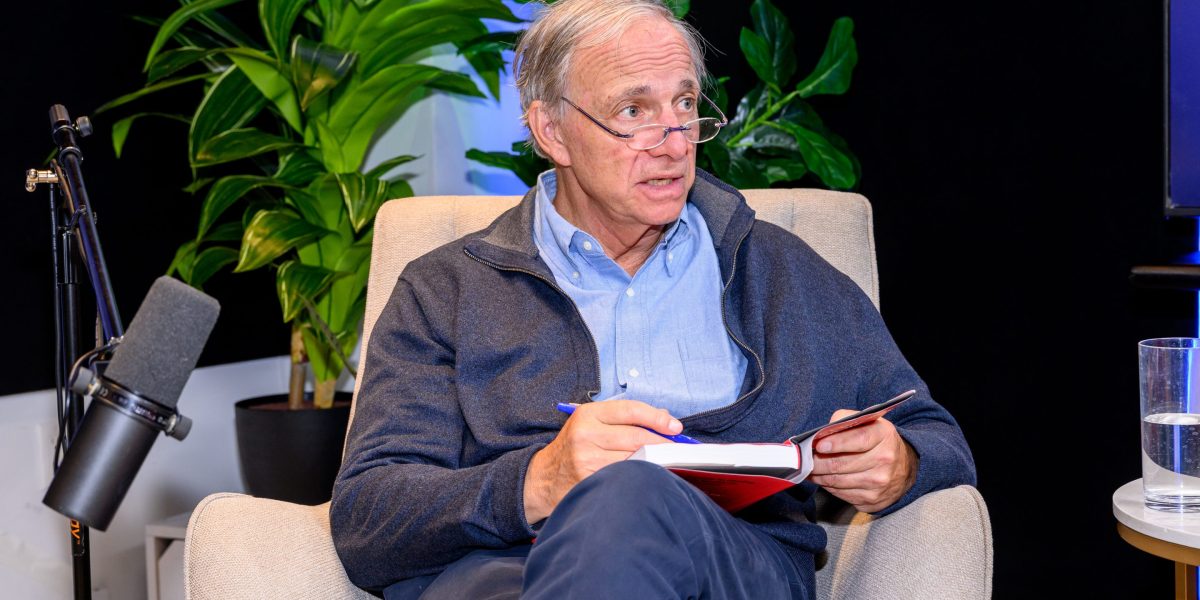
Dalio: AI Bubble Nears 1929 Peak. Wealth Isn’t Money.
Ray Dalio Sounds the Alarm: Why Billionaire Investors Think We’re in an AI Bubble (And What It Means for You)
TL;DR: Legendary investors Ray Dalio and Jeremy Grantham are waving red flags. They believe the current AI stock frenzy looks eerily similar to the 1929 crash, the 2000 dot-com bubble, and the 2007 housing bubble. The "Four Horsemen of the Bubble Apocalypse" are showing up—and Wall Street’s own research teams are starting to agree.
The Conversation That Started It All
On a recent episode of The Diary of a CEO podcast, host Steven Bartlett asked Ray Dalio—founder of Bridgewater Associates, the world’s largest hedge fund—what he thought about fellow investor Jeremy Grantham’s claim that we’re in "the biggest investment bubble in American history."
Dalio’s answer was blunt: "He’s right."
Who Is Jeremy Grantham? (And Why Should We Listen?)
Grantham isn’t just any investor. He’s the co-founder of GMO and has a track record that reads like a highlight reel of bubble-spotting:
- Called the Japanese asset bubble before it burst in the early 1990s
- Predicted the dot-com crash before 2000
- Wrote in Fortune (September 2007) that U.S. housing was in "genuine bubble territory"—months before the Great Financial Crisis, while the Federal Reserve was still dismissing bubble talk
Important Callout: When someone with this track record says "bubble," smart money listens.
The "Bubble Within a Bubble" Theory
Grantham explains our current situation as a "bubble within a bubble":
| Phase | What Happened |
|---|---|
| Original Super-Bubble | Already inflating dangerously through 2021 |
| First Crack | S&P 500 fell ~25% (Jan–Oct 2022) |
| The Plot Twist | ChatGPT launches → "Mag 7" tech stocks lift the entire market on their shoulders |
| The Result | AI didn’t fix overvaluation—it "deferred it while making it larger" |
The Numbers Don’t Lie
Grantham and financial historian Edward Chancellor found that current market metrics (price/book ratios and cyclically adjusted earnings multiples) have only been this extreme four other times in history:
- 1929 → Great Depression
- 1972 → Nifty Fifty crash
- 1999–2000 → Dot-com bust
- 2021 → Post-COVID correction
Every single time was followed by a devastating correction.
The Four Horsemen of the Bubble Apocalypse
Acadian Asset Management’s Owen Lamont created a framework to test if we’re really in a bubble. He calls it the Four Horsemen—and they’re all showing up.
| Horseman | What It Means | Are We There? |
|---|---|---|
| 1. Extreme Overvaluation | Stocks priced way above historical norms | Yes |
| 2. "Bubble Beliefs" | Investors know prices are too high but buy anyway, expecting them to go higher | Yes |
| 3. Surge in Equity Issuance | Companies rushing to sell stock/IPO while prices are high | Happening RIGHT NOW |
| 4. Flood of New Participants | Unsophisticated investors piling in (leveraged ETFs, "crapshooting") | Yes |
Important Callout: Dalio maps directly onto Horseman #3. He says: "There’s almost nothing easier to produce than stock. A company raises $50M, gets valued at $1B, and mints a paper billionaire—without a billion dollars ever changing hands."
The IPO Tsunami: Horseman #3 in Real Time
This isn’t theoretical anymore. The calendar is packed with mega-IPOs:
| Company | Status | Target Valuation | Red Flags |
|---|---|---|---|
| SpaceX | Went public June 2026 | Largest IPO ever | Trading below IPO price; S&P projects negative free cash flow through 2029; Moody’s flags Musk’s voting control as governance risk |
| Anthropic | Confidentially filed, expected Oct 2026 | ~$1 trillion | |
| OpenAI | Filed separately, targeting 2027 (slipped from late 2026) | >$1 trillion | "Shifting market dynamics" cited for delay |
Dalio’s Simple Thought Experiment
"Buy a unit of an AI company for $100. Borrow against that paper wealth. When the market turns and everyone needs cash at once, the price collapses to $25—but the loan still needs repaying."
His core distinction:
Wealth ≠ Money
"You see people getting wealthy but you can’t spend wealth. You have to sell wealth to get money—because you can only spend money."
Dalio’s Verdict: "Classic Signs"
When asked directly if he sees a bubble, Dalio didn’t hedge:
"Yeah. Yeah. Yeah. Classic signs that we’re in [one]."
He emphasizes:
- A bubble is a "degree thing," not binary (on/off)
- Weak-handed, unsophisticated investors are piling into leveraged bets
- Leveraged ETFs tracking the market = "crapshooting"
Grantham adds the why: Markets are "constitutionally incapable of looking further than the present moment"—they extrapolate current conditions and "double-count prosperity" until the excitement itself becomes the risk.
Even Wall Street’s Bulls Are Getting Nervous
This is huge: the most consistently bullish research shops are changing their tune.
| Firm | What They Said (Aug 3, 2026) | Translation |
|---|---|---|
| Goldman Sachs | "There does not appear to be a valuation bubble… there may be an earnings bubble in technology" | Stock prices might make sense if earnings materialize—but those earnings might be a mirage |
| Apollo (Torsten Slok) | "The 60/40 portfolio is broken" | The classic stocks/bonds mix hasn’t worked as predicted for 40 years |
| BCA Research (Peter Berezin) | AI trade is "primarily an earnings bubble rather than a valuation bubble" | Like pre-2008 banks: boom-bust cycle driven by imagined future profits |
The July 26–31 "Reckoning" Week
| Company | Earnings | Stock Reaction | What It Signals |
|---|---|---|---|
| Microsoft | Strong | +18% | Capex credibility rewarded |
| Amazon | Strong | +10% | Capex credibility rewarded |
| Alphabet | Strong | -4% | Spending no longer rewarded just for existing |
| Meta | Strong | -10% | Bubble stage nearing "some kind of reckoning" |
The "Big Cycle": Why This Is Bigger Than Stocks
Dalio doesn’t just see a market cycle—he sees an 80-year "Big Cycle" combining:
- Debt dynamics (too much borrowing)
- Growing wealth gaps (rich get richer, poor get poorer)
- Domestic political conflict (fighting over limited resources)
- Shifting geopolitical power (rising vs. declining empires)
The Two "Pin-Pricks" That Pop Bubbles
Dalio identifies two forces that historically burst bubbles:
| Force | How It Works | Current Status |
|---|---|---|
| Rising Interest Rates | Makes debt expensive to service | Aligns with Slok’s "higher for longer" warning |
| Surge in Stock Issuance | Companies rush to cash in on hype | Happening now (SpaceX, Anthropic, OpenAI) |
A Real-Time Anecdote
Dalio shared a conversation with a friend running an AI company who was raising hundreds of millions specifically because he expected a downturn—planning to use the cash to buy struggling competitors when the market turns.
Important Callout: Even the insiders are preparing for the crash.
The Real Warning: What Comes After the Pop
Dalio’s biggest fear isn’t portfolio losses—it’s what happens socially and politically when the bubble bursts:
"When a bubble bursts, you have people at each other’s throats."
He cites the UK’s six prime ministers in seven years as a symptom: governments run out of money, voters turn on each other over how to raise it, and instability follows.
Grantham takes an even longer view, tying market excess to demographic collapse and resource scarcity.
In Dalio’s telling: The bursting of an AI bubble isn’t just a financial event—it’s the spark for the political and geopolitical conflict that historically accompanies the end of an 80-year cycle.
Summary: What You Need to Know
- Two legendary investors (Dalio + Grantham) agree: We’re in a classic bubble, amplified by AI hype.
- All "Four Horsemen" are present: Overvaluation, bubble beliefs, IPO surge, and new speculators.
- Mega-IPOs are the smoking gun: SpaceX, Anthropic, OpenAI rushing out while the getting’s good.
- Wall Street’s own bulls are flinching: Goldman, Apollo, BCA now warn of "earnings bubbles" and broken models.
- The Big Cycle context: This isn’t just about stocks—it’s about debt, inequality, and political stability.
- Wealth ≠ Money: Paper gains vanish when everyone tries to sell at once.
FAQ: Your Questions Answered
1. Should I sell all my stocks right now?
Not necessarily. Dalio says bubbles are a "degree thing," not a light switch. But do review your leverage, concentration in AI/tech, and whether you’re investing money you can’t afford to lose. Diversification and cash reserves matter more in bubble territory.
2. What’s an "earnings bubble" vs. a "valuation bubble"?
- Valuation bubble: Stock prices are high relative to current earnings (P/E ratio too high).
- Earnings bubble: Current earnings themselves are inflated/unsustainable (e.g., banks in 2007 booking phantom profits from bad loans). If AI capex doesn’t generate real returns, today’s "E" in P/E could evaporate.
3. Why does the 60/40 portfolio matter to me?
The classic 60% stocks / 40% bonds mix has been the default retirement strategy for 40 years. If it’s "broken" (stocks and bonds falling together, as in 2022), your retirement plan may need rethinking—more diversification, alternatives, or active management.
4. Is AI itself a scam?
No. Dalio and Grantham aren’t saying AI is fake—they’re saying the financial speculation around it has detached from reality. The internet was real in 1999 too; that didn’t stop Pets.com from going to zero.
5. What’s the single best thing I can do to prepare?
Understand the difference between wealth and money. Don’t borrow against paper gains. Keep dry powder (cash/short-term bonds). Avoid leverage. And remember: bubbles can stay irrational longer than you can stay solvent—but they always revert.
Final Thought: The smartest investors in history are screaming "CAUTION" in unison. You don’t have to panic—but you do have to pay attention. The cost of ignoring them could be far higher than the cost of preparing.