Giants of Steel: The World’s 10 Tallest Skyscrapers Ranked
The Race to the Sky: How We Measure the World’s Tallest Buildings
Have you ever wondered who decides which building is the "tallest"? It’s not as simple as measuring from the ground to the tip. Let’s break down the rules, the drama, and the current champions of the skyscraper world.
The Great Height Debate of 1996
Back in 1996, a massive argument broke out in the architecture world. The fight was between two giants:
- The Petronas Towers in Kuala Lumpur, Malaysia
- The Sears Tower (now Willis Tower) in Chicago, USA
The problem: The Petronas Towers had a lower roof, but they wore pointy spires (decorative pointy tops) like crowns. The Sears Tower had a higher roof but only had antennas (skinny metal sticks for TV/radio signals) on top.
So, which one was actually taller?
To settle this once and for all, a non-profit group called the Council on Tall Buildings and Urban Habitat (CTBUH) stepped in. They created the first official "World’s Tallest Buildings" list and set a golden rule that we still use today:
Spires count toward height. Antennas, signs, and technical equipment do not.
Because the Petronas Towers’ spires are part of the building’s design (they’re permanent and architectural), they won. The Sears Tower’s antennas were just "equipment," so they didn’t count.
The Official Rulebook: How to Measure a Giant
The CTBUH didn’t stop at spires vs. antennas. They wrote a whole rulebook to make sure everyone plays fair. Here are the four main rules:
1. Start at the Front Door
Height is measured from the main pedestrian entrance (where people walk in) up to the architectural top (the highest permanent part of the design). No measuring from the basement or the subway level!
2. The "50% Rule" – Building vs. Tower
To be a building (skyscraper), at least 50% of its height must be usable floor space (offices, homes, hotels).
- Tokyo Skytree (634 m) → Tower. It’s mostly a TV broadcast stick with a tiny observation deck. It doesn’t make the list.
- Shanghai Tower (632 m) → Building. People work and live inside most of it.
3. "Finished Means Finished"
No half-built wonders allowed! To be ranked, a skyscraper must be:
- Structure complete
- Cladding (outer skin) complete
- Doors open to the public
Construction sites—even ones that look almost done—are excluded.
4. Spires Count, Antennas Don’t (The Golden Rule)
- Spire = Permanent, architectural, part of the look → COUNTS
- Antenna/Sign/Flagpole = Technical, removable, functional → DOESN’T COUNT
Important Callout: The "Vanity Height" Trick
Because spires count, architects started adding really tall, empty spires just to climb the rankings. This useless space is called "Vanity Height."
The King of Vanity: The Burj Khalifa has 244 meters (800 ft) of vanity height—that’s almost a third of its total height! If you chopped off its spire, it would drop several spots on the list.
A New Name, Same Mission
In October 2025, the CTBUH got a rebrand. They are now called the Council on Vertical Urbanism.
Don’t worry—their database (The Skyscraper Center) and their rules haven’t changed. They are still the only official source the industry trusts.
The Current Champions: Top 5 Tallest Buildings (Right Now)
The rankings have been frozen at the top for 16 years—the longest streak since the Empire State Building! Here are the current leaders:
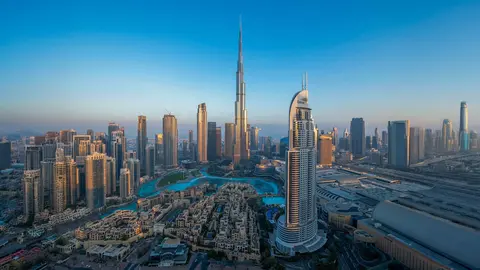
1. Burj Khalifa — Dubai, UAE — 828 m (2,717 ft)
- Designer: Adrian Smith (SOM)
- Secret Sauce: A "buttressed core"—imagine a strong concrete spine running down the middle, braced by three wings like a tripod. This lets it go super tall without wobbling.
- Fun Fact: It was almost named "Burj Dubai," but the ruler of Abu Dhabi bailed out the project during the 2008 financial crisis, so they renamed it in his honor ("Khalifa").
2. Merdeka 118 — Kuala Lumpur, Malaysia — 679 m (2,227 ft)
- Name Meaning: "Merdeka" = Independence. "118" = Number of floors.
- Designer: Fender Katsalidis
- Cool Feature: A faceted façade (like a cut diamond) that reflects light differently at sunrise, noon, and sunset.
- Local Hero: It stole the "tallest in Malaysia" title from the nearby Petronas Towers (held since 1998).
3. Shanghai Tower — Shanghai, China — 632 m (2,073 ft)
- Designer: Gensler (USA)
- Superpower: It twists 120° as it rises. This isn’t just for looks—it cuts wind load by ~25% (like twisting your hand out a car window reduces drag).
- Green Tech: Double-skin glass façade (two layers of glass with a gap in between). Inside that gap? 270 wind turbines generating power!
4. Makkah Royal Clock Tower — Mecca, Saudi Arabia — 601 m (1,972 ft)
- Designer: Dar Al-Handasah (Lebanon)
- Part of: Abraj Al-Bait complex (7 towers next to the Great Mosque).
- The Clock: Visible from 25+ km away—the world’s largest clock face.
- Purpose: Houses Hajj pilgrims. It’s the tallest building ever built explicitly for religious purposes.
5. Ping An Finance Center — Shenzhen, China — 599 m (1,965 ft)
- Designer: Kohn Pedersen Fox (KPF)
- Structure: Four corner columns that get slimmer as they go up (like a pinch).
- Skin: 1,700 tonnes of stainless steel cladding—chosen to survive Shenzhen’s intense humidity and salt air.
- Distinction: Tallest all-office building on the list (no hotels, no apartments—just desks).
The Future: Chasing the "Kilometer" Dream
Architects have dreamed of a 1 km (1,000 m) tall building for 100 years. Two contenders are trying, but both are stuck in "construction limbo":
| Building | Target Height | Status |
|---|---|---|
| Jeddah Tower (Saudi Arabia) | 1,008 m | Started 2013 → Paused 2017 → Restarted 2023 |
| Dubai Creek Tower (UAE) | ~1,000+ m (exact secret) | Multiple stops/starts |
The 1-kilometer barrier remains unbroken. Who will cross it first? Stay tuned!
Summary: Key Takeaways
- CTBUH (now Council on Vertical Urbanism) is the referee for skyscraper height.
- Spires count; antennas don’t. This settled the 1996 Petronas vs. Sears fight.
- Must be a "building" (50% occupiable), finished, and measured from the front door.
- Vanity Height is real—empty spires added just for ranking points.
- Burj Khalifa has reigned #1 since 2010 (16 years!).
- The Top 5 are spread across Dubai, Malaysia, China, and Saudi Arabia.
- The 1 km dream is alive but delayed—Jeddah Tower and Dubai Creek Tower are the hopefuls.
FAQ: Your Burning Questions Answered
Why don’t antennas count? They’re on top!
Think of it like a hat vs. a headband. A spire is like a crown—it’s part of the outfit, sewn on permanently. An antenna is like a headlamp clipped on later for a job (broadcasting). You wouldn’t measure a person’s height including their removable headlamp!
If Tokyo Skytree is taller than Shanghai Tower, why isn’t it #3?
It’s a "tower," not a "building." Remember the 50% Rule? Tokyo Skytree is basically a giant needle for TV signals. Almost zero people live or work inside its height. It’s in a different category (like the CN Tower or Eiffel Tower).
What is "cladding"?
Cladding is the building’s "skin." It’s the outer layer (glass, metal, stone) that protects the skeleton from rain, wind, sun, and makes it look pretty. Ping An Finance Center uses stainless steel armor because Shenzhen’s air is salty and humid.
How does twisting a building help with wind?
Imagine a smooth cylinder vs. a twisted rope. Wind hits a flat side hard and creates strong vortices (swirling winds) that shake the tower. The twist breaks up those vortices, "confusing" the wind so it pushes less violently. Shanghai Tower saves 25% structural material this way!
Will Jeddah Tower actually finish?
Nobody knows for sure. It has serious funding and political hurdles. Construction restarted in 2023, but building a 1 km tower takes 5–7+ years minimum if money flows perfectly. The "Kilometer Club" remains exclusive—for now.