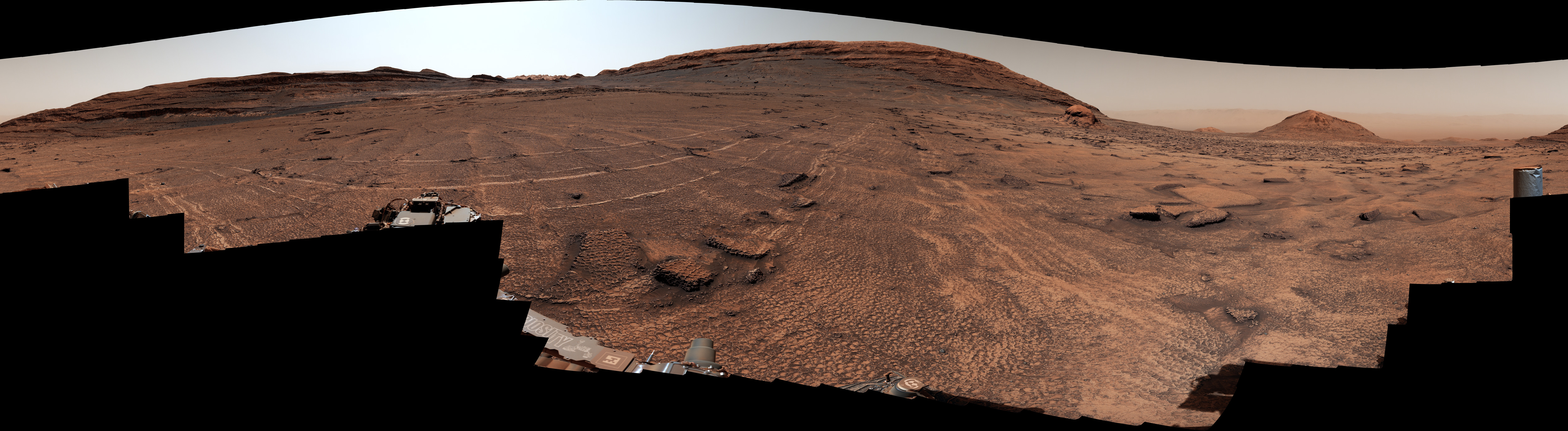
NASA’s Curiosity Just Found a Bizarre Honeycomb Landscape on Mars
NASA’s Curiosity Rover Finds a Giant "Honeycomb" on Mars
TL;DR: The Curiosity rover just discovered a massive field of honeycomb-shaped cracks on Mars. These patterns might be ancient mud cracks, which would be more proof that Mars once had lakes and the right ingredients for life.
What Did Curiosity Find?
Imagine walking through a dried-up mud puddle in your backyard. You see those little polygon shapes cracked into the dirt? Curiosity just found a giant version of that on Mars.
While exploring a valley nicknamed "Valle Grande" (Spanish for "Big Valley"), the rover took a 360-degree panorama. As far as its cameras could see, the ground was covered in a "sea of polygons."
The Vital Stats
- Shape: Honeycomb-like polygons (geometric shapes with straight sides)
- Size: Each polygon is 1.5 to 3 inches (4 to 8 centimeters) across — about the size of a cookie or a credit card.
- Location: A valley called Valle Grande on the slopes of Mount Sharp.
- Scale: Unlike small patches seen before, this field stretches in all directions and even wraps around a nearby 20-foot-tall (6-meter) hill nicknamed "Miraflores."
- When: Photos taken on June 19–20, 2024 (Martian days, or "sols," 4,930 and 4,931).
IMPORTANT POINT
Why do scientists care about cracks in the dirt?
On Earth, these patterns usually form when wet mud dries out and shrinks. Finding them on Mars is a huge clue that liquid water was once present — and where there was water, there could have been life.
How Do These Shapes Form?
There are a few ways nature makes polygon patterns. Scientists are investigating which one happened here.
1. Mud Cracks (The Leading Theory)
- Wet mud dries up → shrinks → cracks into polygons.
- Meaning: Definite proof of ancient water.
2. Freeze-Thaw Cycles
- Ground gets wet → freezes (expands) → thaws (contracts) → repeats.
- Over time, this stress cracks the soil into polygons.
- Meaning: Requires water/ice and big temperature swings.
3. Compression Squeeze
- Layers of sediment pile up on top → pressure squeezes water out → cracks form.
- Meaning: Happens deep underground, later exposed by erosion.
Fun Fact: Curiosity has seen small patches of polygons before, and some were confirmed as ancient mud cracks. But nothing this big or widespread!
Why Is This a Big Deal? (The "So What?")
Curiosity has been roving Mars since August 5, 2012 — that’s 14 years! In that time, it has climbed Mount Sharp, a mountain 3 miles (5 km) tall.
The Big Picture: Ancient Mars Was Habitable
Billions of years ago, the lower foothills of Mount Sharp were dotted with lakes and streams. Curiosity has found the chemical receipts:
| Discovery | What It Tells Us |
|---|---|
| Clay minerals | Formed in neutral-pH water (drinkable!) |
| Sulfates | Left behind as water evaporated |
| Carbon-based molecules | Precursors to RNA & DNA (the code of life) |
| Energy sources | Chemicals microbes could "eat" |
| Nutrients | Sulfur, nitrogen, oxygen, phosphorus, carbon |
IMPORTANT POINT
Did Curiosity find life?
No. The organic molecules could come from biology OR geology (non-living chemical reactions). We can’t tell the difference yet. But finding them reconfirms the kitchen had all the ingredients to bake life.
Curiosity’s Greatest Hits Album
Besides the new honeycomb field, the rover has spotted some wild things:
- Sulfur Crystals — Pure yellow crystals inside a crushed rock (very rare!).
- Shiny Meteorites — Space rocks that survived the trip through Mars’ thin atmosphere.
- "Martian Flower" — A tiny, delicate mineral formation that looks like a coral or flower.
- Ancient Stream Beds — Rounded pebbles cemented together, proof of flowing water.
How the Mission Works
- NASA HQ (Washington) sets the goals & budget.
- JPL (Jet Propulsion Laboratory) (Pasadena, CA) builds the rover & drives it daily.
- Caltech manages JPL for NASA.
- Scientists worldwide analyze data & plan the next moves.
Summary
- Curiosity found a massive field of honeycomb polygons in "Valle Grande."
- They look exactly like mud cracks on Earth — strong evidence for ancient lakes.
- This fits the bigger story: Mount Sharp was once a watery, habitable environment.
- Organic molecules (life’s building blocks) are there, but we don’t know if they’re from life or rocks.
- After 14 years, the rover is still climbing, still discovering.
FAQ
1. How big is the Curiosity rover?
About the size of a small SUV (roughly 10 ft long, 9 ft wide, 7 ft tall). It weighs ~2,000 lbs (900 kg) on Earth, but only ~750 lbs on Mars due to lower gravity.
2. What is a "sol"?
A Martian day. It’s 24 hours, 39 minutes — slightly longer than an Earth day. Mission teams live on "Mars time" to match the rover’s schedule.
3. Can Curiosity detect life directly?
No. It’s a geology/chemistry lab on wheels. It identifies habitability (could life survive?) and biosignatures (chemical hints), but it doesn’t have a microscope to see microbes or a DNA sequencer.
4. How does the rover send photos back?
It beams data to orbiters circling Mars (like Mars Reconnaissance Orbiter), which relay it to Earth’s Deep Space Network (giant antennas in California, Spain, Australia).
5. Where can I see the raw images?
Right now! NASA posts them publicly:
Curiosity Raw Images
You can browse the exact photos scientists use — including the new polygon panorama!
Learn More
- Mission Homepage: science.nasa.gov/mission/msl-curiosity
- Recent Mud Crack Discovery: NASA Article
- Organic Molecules Finding: NASA Article
Article based on NASA/JPL-Caltech press release (2026-051). Media contacts: Andrew Good (JPL), Karen Fox & Alana Johnson (NASA HQ).