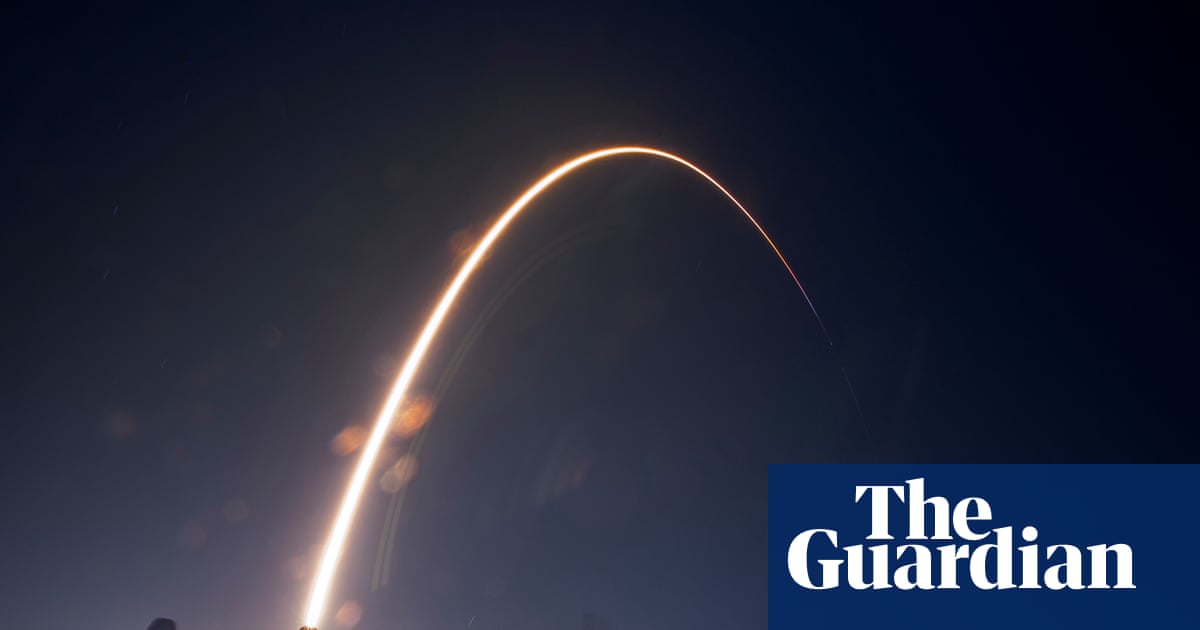
Rogue SpaceX Rocket on Collision Course With Moon After 7-Year Drift
SpaceX Rocket Set to Crash Into the Moon: What You Need to Know
The Big News: A Rocket Is About to Hit the Moon
Imagine throwing a baseball into the sky and having it land on the moon a year later. That’s basically what’s happening this Wednesday — except the "baseball" is a 4-ton rocket booster the size of a school bus, traveling at 5,400 mph (that’s 7 times the speed of sound!).
Important Point: This was not planned. SpaceX didn’t aim for the moon — the rocket just got stuck in a weird orbit after delivering its payload over a year ago.
How Did This Happen? The Rocket’s Journey
- February 2023: A SpaceX Falcon 9 rocket launched from Florida carrying two lunar landers (robotic spacecraft designed to land on the moon).
- Job Done: The rocket’s first stage (the big bottom part) returned to Earth and landed safely — standard SpaceX procedure.
- Left Behind: The upper stage (the smaller top part that pushes the payload to its final destination) did its job but didn’t have enough fuel to escape Earth-Moon gravity.
- Stuck in Limbo: For over a year, this 4-ton metal tube has been tumbling in a chaotic orbit around Earth and the Moon.
- Wednesday: Gravity finally wins. The rocket will slam into the Moon’s near side (the side facing Earth).
Crash Details: When, Where, and How Big?
| Detail | What It Means |
|---|---|
| Speed | 5,400 mph (8,700 km/h) — 7× speed of sound |
| Location | Near Einstein Crater on the Moon’s sunlit western edge |
| Energy | Equivalent to 3 tons of TNT exploding |
| Crater Size | Predicted: ~90 feet wide, 16 feet deep (27m × 5m) |
| Flash Duration | Less than 1 second (too faint to see from Earth) |
| Debris Plume | Dust and rocks shooting miles high, visible to telescopes for tens of minutes |
Why Do Scientists Care? (It’s Not Just a Cool Explosion)
1. Free Science Experiment
- No wind, low gravity = dust hangs in the air for a long time.
- Telescopes (and maybe backyard astronomers!) can watch the ejecta curtain — the fountain of moon dirt — to learn what’s under the surface.
2. Astronaut Safety
"We want to know how much of a hazard debris impacts pose to future astronauts." — Benjamin Fernando, Los Alamos National Laboratory
If a random rocket makes a 90-foot crater, what does a micrometeoroid do to a moon base?
3. Spacecraft Get Front-Row Seats
- NASA’s Lunar Reconnaissance Orbiter (LRO)
- South Korea’s Danuri Orbiter
Both will snap before-and-after photos of the fresh crater.
The Bigger Picture: Space Junk Is Piling Up
"Things are getting crowded up there." — Bill Gray, Space Tracking Expert
- This is the 2nd known accidental rocket crash on the Moon.
- 2022: A Chinese rocket stage hit the far side, making a double crater.
- The Lesson: We need better rules for disposing of rocket bodies — like nudging them into orbit around the Sun instead of leaving them in the Earth-Moon neighborhood.
Can You See It? Viewing Guide
| Region | Visibility |
|---|---|
| Eastern US & Canada | Best view (predawn hours Wednesday) |
| South America | Good view |
| Western US / Europe / Asia | Missed it (daytime or Moon below horizon) |
| Naked Eye | No — flash too dim |
| Backyard Telescope (6-inch+) | Maybe! Look for the expanding dust plume near the western limb |
Pro Tip: Check apps like SkySafari or Stellarium for exact timing at your location.
Key Takeaways: What You Should Remember
- Unplanned crash: SpaceX rocket upper stage from Feb 2023 launch.
- Wednesday impact: ~5,400 mph near Einstein Crater (Moon’s near side).
- Scientific goldmine: Fresh crater + dust plume = free data on lunar geology & impact physics.
- Wake-up call: Highlights growing space junk problem; need better disposal plans.
- Orbiters watching: NASA’s LRO & Korea’s Danuri will document the new crater.
- You might see the dust cloud with a decent telescope if you’re in the right place at the right time.
Summary
A wayward SpaceX rocket booster — abandoned in space after a 2023 lunar mission — is set to crash into the Moon this Wednesday at hypersonic speed. While the impact flash won’t be visible from Earth, the resulting dust plume and fresh ~90-foot crater offer scientists a rare, unplanned opportunity to study impact mechanics, lunar subsurface material, and risks to future astronauts. The event underscores a growing concern: space junk isn’t just an Earth-orbit problem anymore. As lunar traffic increases, so does the need for responsible end-of-life plans for rockets. NASA and Korean orbiters will capture the aftermath, and lucky skywatchers in the Americas might glimpse the rising debris cloud through telescopes.
FAQ: Your Questions Answered
Was this SpaceX’s fault?
Not exactly. The rocket did its job delivering the landers. The upper stage just didn’t have fuel left to escape the Earth-Moon system. Experts say a small nudge toward a solar orbit could have prevented it — a standard practice that wasn’t done here.
Is this dangerous for us on Earth?
No. The Moon has no atmosphere, so no shockwaves reach Earth. The debris stays on the Moon. It poses zero risk to people or satellites.
Why didn’t they just crash it into Earth to burn up?
The upper stage was too high and moving too fast to easily target Earth reentry. It would have required significant extra fuel — fuel that was used to get the landers to the Moon.
Will this ruin the Moon?
Not at all. The Moon is covered in craters from billions of years of impacts. This one is tiny by lunar standards. Think of it like a pebble hitting a sandbox.
What happens to the crater now?
It’ll sit there essentially forever — no wind, rain, or tectonic activity to erase it. Future lunar explorers might even visit it as a landmark: "Here lies the Falcon 9 upper stage, 2023–2025."