Hubble Reveals Andromeda’s Star Factory Is Shutting Down
Hubble Discovers Andromeda Galaxy Is Taking a "Cosmic Breather" from Star-Making
What Did Scientists Discover?
A new study using NASA’s Hubble Space Telescope has found that our galactic neighbor, the Andromeda galaxy, has been slowing down its star-making factory for the last 500 million years—and the slowdown has gotten much steeper in the last 40 million years.
Important Point: Think of Andromeda like a marathon runner who just finished a huge race (a giant burst of star formation 2 billion years ago) and is now catching its breath. It’s not running out of energy (gas and dust); it’s just naturally winding down.
Meet Andromeda: Our Cosmic Next-Door Neighbor
- Distance: About 2.5 million light-years from Earth (practically next door in cosmic terms!)
- Size: A spiral galaxy similar in size to our Milky Way
- Visibility: Can be seen with the unaided eye from dark-sky locations
- Why it matters: Because it’s so close, astronomers can study its stars in incredible detail—like reading a history book of how galaxies like ours live and evolve.
How Did Scientists Figure This Out? (The Cosmic Detective Work)
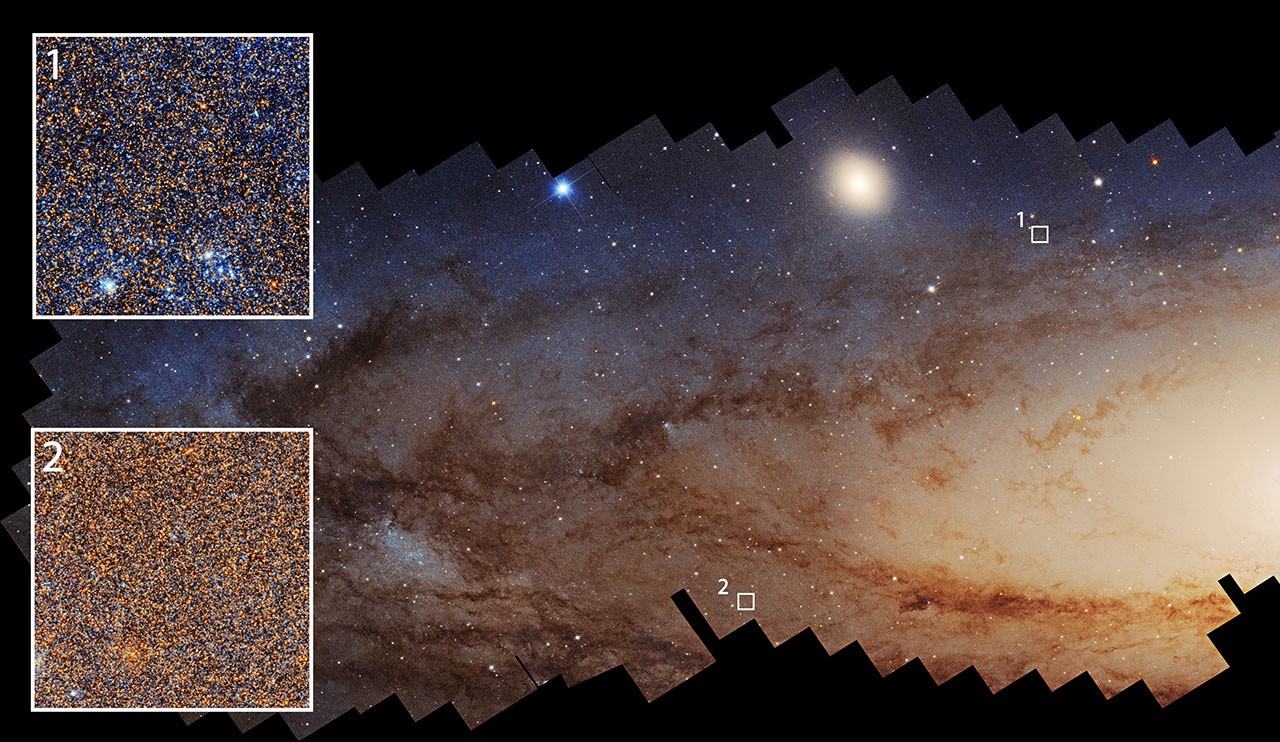
Researchers combined data from two massive Hubble surveys to create a ultra-detailed map of Andromeda:
- PHAT (Panchromatic Hubble Andromeda Treasury) – mapped the northern half
- PHAST (Panchromatic Hubble Andromeda Southern Treasury) – mapped the southern half
Together, they covered two-thirds of Andromeda’s disk.
The "Fossil Record" Method
- Hubble measured ~200 MILLION individual stars
- Massive stars = Blue, bright, short-lived (millions of years)
- Small stars = Red, dim, long-lived (billions of years)
- The trick: By counting blue vs. red stars in a region, scientists know when stars formed there.
- The grid: They divided Andromeda into thousands of squares (each 300 light-years wide) to build a timeline for the whole galaxy.
Key Quote: "We need to measure the individual stars because they are the fossil record of the galaxy’s formation. Hubble is the only telescope that can give you high enough spatial resolution over a large enough area to do that in Andromeda." – Ben Williams, University of Washington
The Star Formation Timeline: From Sprint to Stroll
| Time Period | Star Formation Rate | What Was Happening |
|---|---|---|
| ~2 Billion Years Ago | PEAK ACTIVITY | A dramatic "starburst"—likely caused by a collision/merger with another galaxy. |
| 500 Million Years Ago | ~1 Solar Mass per year | Steady decline begins after the big burst. |
| 40 Million Years Ago | ~0.5 Solar Masses per year | Rate drops by half. |
| Right Now | ~0.2 Solar Masses per year (1/5th of the Sun’s mass) | Rate has plummeted even further. |
Where Is the Slowdown Happening?
- Most recent star formation was concentrated in a "star-forming ring" about 32,000 light-years from the center.
- The decline is driven almost entirely by this ring quieting down.
- It’s NOT because they ran out of gas/dust—it’s a natural "cooling off" after the massive starburst party 2 billion years ago.
The Mysterious Case of the Tiny Neighbor: M32
Andromeda has a small satellite galaxy called M32 (Messier 32) orbiting nearby (~16,000 light-years away in the sky).
The Clue Near M32
- The team studied the area of Andromeda’s disk closest to M32 using the new PHAST data.
- Finding: Star formation dropped sharply ~60 million years ago in this specific zone.
- The Suspect: M32 is "right there" and is the most likely culprit for this localized drop.
- The Caveat: We don’t know M32’s exact 3D path, so we can’t prove it caused the dip—but the timing is suspicious.
Key Quote: "We can’t explicitly say that we are seeing a decrease in star formation because of M32. But it’s right there, and it’s definitely the most likely suspect." – Tobin Wainer, Lead Author
What’s Next? The Future of Galactic Archaeology
- More Hubble Analysis: The team keeps digging into this treasure trove of data.
- Ground-Based Team-Up: Combining Hubble’s sharp vision with ground telescopes’ different "eyes" (spectra).
- Enter the Roman Space Telescope (Launching as early as Aug 30, 2027):
- Superpower: Field of view 100x larger than Hubble at near-infrared wavelengths.
- Mission: Image ALL of Andromeda’s disk and halo in just a few pointings.
- Result: Measure hundreds of millions of stars → Revolutionary new science.
Summary: The Big Picture
- Andromeda had a huge star-making party 2 billion years ago (likely a galaxy merger).
- Since then, it’s been on a long, steady decline in star formation.
- Last 500 Myr: Rate dropped from 1 → 0.5 → 0.2 Solar masses/year.
- Main driver: A specific star-forming ring quieting down (natural wind-down, not fuel shortage).
- Bonus mystery: Tiny neighbor M32 may have punched a hole in the disk ~60 Myr ago, causing a local star-formation dip.
- Hubble’s "fossil record" of 200M stars made this timeline possible.
- NASA’s Roman Telescope will soon give us the complete, high-def movie of Andromeda’s life.
FAQ: Your Burning Questions Answered
1. Is Andromeda "dying"?
No! It’s not running out of gas. It’s just transitioning from a starburst phase to a quieter, steady phase—like a runner catching their breath after a sprint. It will still form stars, just much more slowly.
2. Why can’t we study the Milky Way this easily?
We live inside it! Imagine trying to map your whole house while stuck in the hallway. Andromeda is close enough to see face-on, giving us a perfect "global view" impossible for our own galaxy.
3. What is a "Solar Mass per Year"?
It’s the standard unit for star formation rate. 1 Solar Mass = the mass of our Sun. So "1 solar mass/year" means the galaxy makes the equivalent of one Sun’s worth of new stars every year (could be many small stars or a few big ones).
4. Did M32 definitely cause the local star-formation drop?
Not 100% proven. We don’t know M32’s exact 3D orbit. But the timing (60 Myr ago) and location (right next to M32) make it the prime suspect. Future data (especially from Roman) will help solve this whodunit.
5. Why is the Roman Space Telescope such a game-changer for this?
Speed and scope. Hubble took years to mosaic 2/3 of Andromeda. Roman can image the entire galaxy (disk + halo) in a handful of shots with similar sharpness. It turns a "slow scan" into an "instant panoramic photo" of hundreds of millions of stars.