

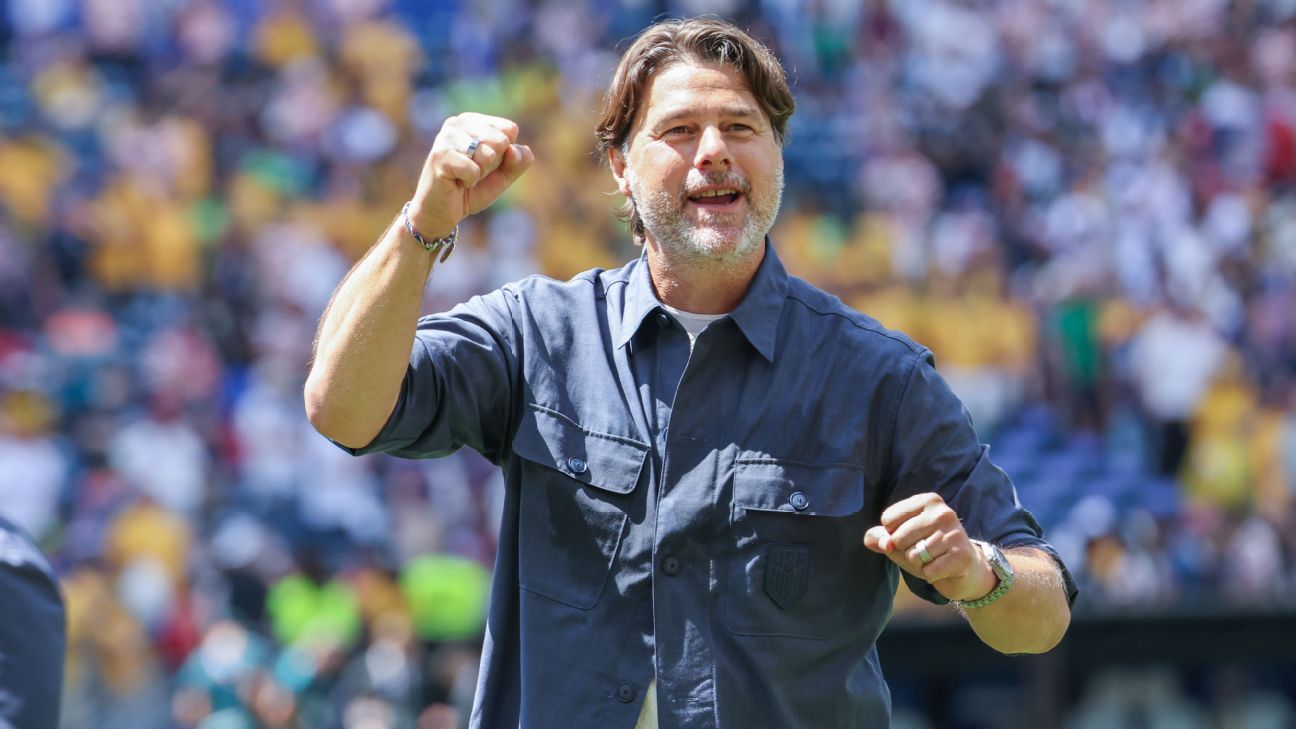
Will Europe Steal Pochettino From the USMNT?
Mauricio Pochettino Stays as USMNT Coach Through 2030 World Cup: What It Means for American Soccer
The Big News: Pochettino Signs Four-Year Extension
Mauricio Pochettino — the Argentine coach who took over the U.S. Men’s National Team (USMNT) in 2024 — has officially signed a new contract to stay in charge through the 2030 FIFA World Cup. This comes despite:
- Rumors he might leave for AC Milan (a famous Italian club) earlier this year
- A disappointing Round of 16 loss to Belgium at the 2026 World Cup
ESPN gathered four soccer experts — Jeff Carlisle, Bill Connelly, Cesar Hernandez, and Lizzy Becherano — to break down what worked, what needs fixing, and whether he’ll actually stay for all four years.
What Went Right in Pochettino’s First Two Years?
1. He Brought Accountability (Jeff Carlisle)
- Before Pochettino: Players got comfortable. Starting spots felt guaranteed.
- After Pochettino: No one’s spot was safe. Playing time had to be earned every day.
- Result: The team showed real "buy-in" at the World Cup — everyone fought for each other.
- Key for the future: He must keep bringing in new young players to challenge the veterans, or the team gets stale again (like it did under previous coach Gregg Berhalter).
2. He Built a Fun, Cohesive Playing Style (Bill Connelly)
- The core players had barely played together in the previous four years.
- Pochettino quickly got them playing connected, aggressive soccer that used their speed and athleticism.
- Reminded Connelly of Pochettino’s exciting Tottenham Hotspur teams — but without the exhaustion of a 9-month club season.
- Special shoutout: He discovered and developed right-back Alex Freeman quickly.
3. He Changed the Culture (Cesar Hernandez & Lizzy Becherano)
- Hernandez: The team’s identity and mentality shifted. Even if you disagree with some selections (like leaving Diego Luna off the roster), the overall roster level went up.
- Becherano: Veteran defender Tim Ream said training became intense — "everything matters, every single day from the minute you wake up until you go to sleep."
- Pochettino brought the passion he grew up with in Argentina to the U.S. setup.
IMPORTANT POINT:
Culture change isn’t just about tactics — it’s about standards, discipline, and daily habits. Pochettino made training feel like a must-win game.
What Needs Improvement Over the Next Four Years?
1. Stop Worrying About Things He Can’t Control (Jeff Carlisle)
- Example 1: Complaining about pro-Mexico crowds at the 2025 Gold Cup (U.S. fans were outnumbered).
- Example 2: Saying after losses to Belgium and Portugal that the U.S. doesn’t have players in the world’s top 100.
- Why it matters: These are excuses, not solutions. They don’t help players — they just deflect blame.
- Fix: Accept reality. World Cup qualifying will be ugly and uncomfortable. Focus only on what the team can control.
2. Fix the "Wide-Open" Defense (Bill Connelly)
- The risk: Playing aggressive, attacking soccer leaves big gaps at the back.
- The proof: Against the six highest-ranked FIFA opponents this year, the U.S. conceded 18 goals.
- The weak spot: Center back depth is arguably the thinnest position in the player pool.
- Balance needed: This style helps avoid upsets in qualifying, but elite teams will punish you if you don’t tighten up.
3. Win the Dual-National Recruiting Battles (Cesar Hernandez)
- The U.S. keeps losing Mexican-American talents to El Tri (Mexico’s national team).
- Recent losses: Brian Gutiérrez and Obed Vargas — both could’ve helped the USMNT but chose Mexico.
- Why it hurts: These are prime-age players developing in top leagues. Losing them weakens the pool long-term.
4. Find Consistency — Not Just Flashes of Brilliance (Lizzy Becherano)
- Highs: Dominated group-stage games vs. Paraguay and Australia — controlled play, created chances, looked organized.
- Low: Completely disappeared vs. Belgium in the knockout round. Looked like a different team.
- The challenge: Talent exists. Maintaining that level for 90 minutes, across 4-7 tournament games, is the next step.
Will He Actually Stay for All Four Years? The "European Exit" Risk
| Expert | Verdict | Key Reasoning |
|---|---|---|
| Jeff Carlisle | Very real threat | Pochettino’s history: gets fired or leaves after a season. 4 years is a long slog of qualifying + Nations League + Gold Cup. Contract buyout clause will decide it. USSF needs a backup plan. |
| Bill Connelly | Less real now… but not zero | He re-signed because money + lack of better club offers made it the best choice. But 4 years is forever in soccer. He’ll be 58 in 2030. A big Premier League job could still tempt him. |
| Cesar Hernandez | He’d rather be in Europe | Pochettino has openly flirted with returning to the Premier League to prove himself. The paycheck might keep him — but his heart is in club football. |
| Lizzy Becherano | He’ll finish the project | He’s transparent about missing the Premier League ("best in the world, I miss it"). But she believes he intends to see this through to 2030 — which could mean a World Cup game in his native Argentina. |
IMPORTANT POINT:
International coaching is part-time (camps, windows, tournaments). Club coaching is daily, year-round grind. Pochettino is a club coach at heart. The pull of the Premier League is strong.
Summary: What This Means for U.S. Soccer
- Stability secured — The USMNT has a proven, high-level coach for the entire 2030 cycle.
- Culture is fixed — Accountability, intensity, and "everything matters" are now baseline expectations.
- Style is exciting but risky — High-octane attack works vs. most CONCACAF teams; elite opponents will expose defensive gaps.
- Roster depth is the real job — Developing center backs, winning dual-national battles, and keeping the player pool fresh are more important than tactics.
- The clock is ticking — Pochettino says he’s committed. History says have a Plan B ready.
FAQ: Your Questions Answered
Q: Why did Pochettino sign an extension if he wants to coach in Europe?
A: The timing worked out. No top European club had a clear opening right now, and U.S. Soccer offered a strong contract. He gets four paid years to build something historic — with a World Cup on home soil (2026) and possibly in Argentina (2030). It’s a great fallback that became the best option.
Q: What is a "dual-national" and why does it matter?
A: A player eligible for two countries (e.g., born in the U.S. to Mexican parents). The U.S. and Mexico compete fiercely for these kids. Losing Gutiérrez and Vargas to Mexico means the USMNT missed out on two high-potential midfielders who are now starring abroad.
Q: Is the U.S. defense really that bad?
A: Not "bad" — but thin at center back. The starting duo (likely Tim Ream and Chris Richards or Miles Robinson) is solid. But behind them? Very little proven international quality. One injury or suspension (like Folarin Balogun’s red card vs. Belgium) forces risky adjustments.
Q: Can Pochettino actually win a World Cup knockout game with this team?
A: Yes — if he solves consistency. The talent level (Pulisic, Musah, Reyna, McKennie, Adams, etc.) is highest in U.S. history. The 2026 group stage showed they can dominate games. The Belgium loss was a mental/structural collapse, not a talent gap. Four years is time to fix it.
Q: What happens if Pochettino leaves before 2030?
A: U.S. Soccer must have a succession plan (Carlisle’s point). Likely candidates: B.J. Callaghan (interim 2023), Nancy (youth coach), or a European-based American coach like Jesse Marsch or Gregg Berhalter (again). The federation cannot be caught scrambling again.
Article based on ESPN expert analysis by Jeff Carlisle, Bill Connelly, Cesar Hernandez, and Lizzy Becherano. Original reporting by Bill Connelly, Cesar Hernandez, and Lizzy Becherano. Published August 3, 2026.


