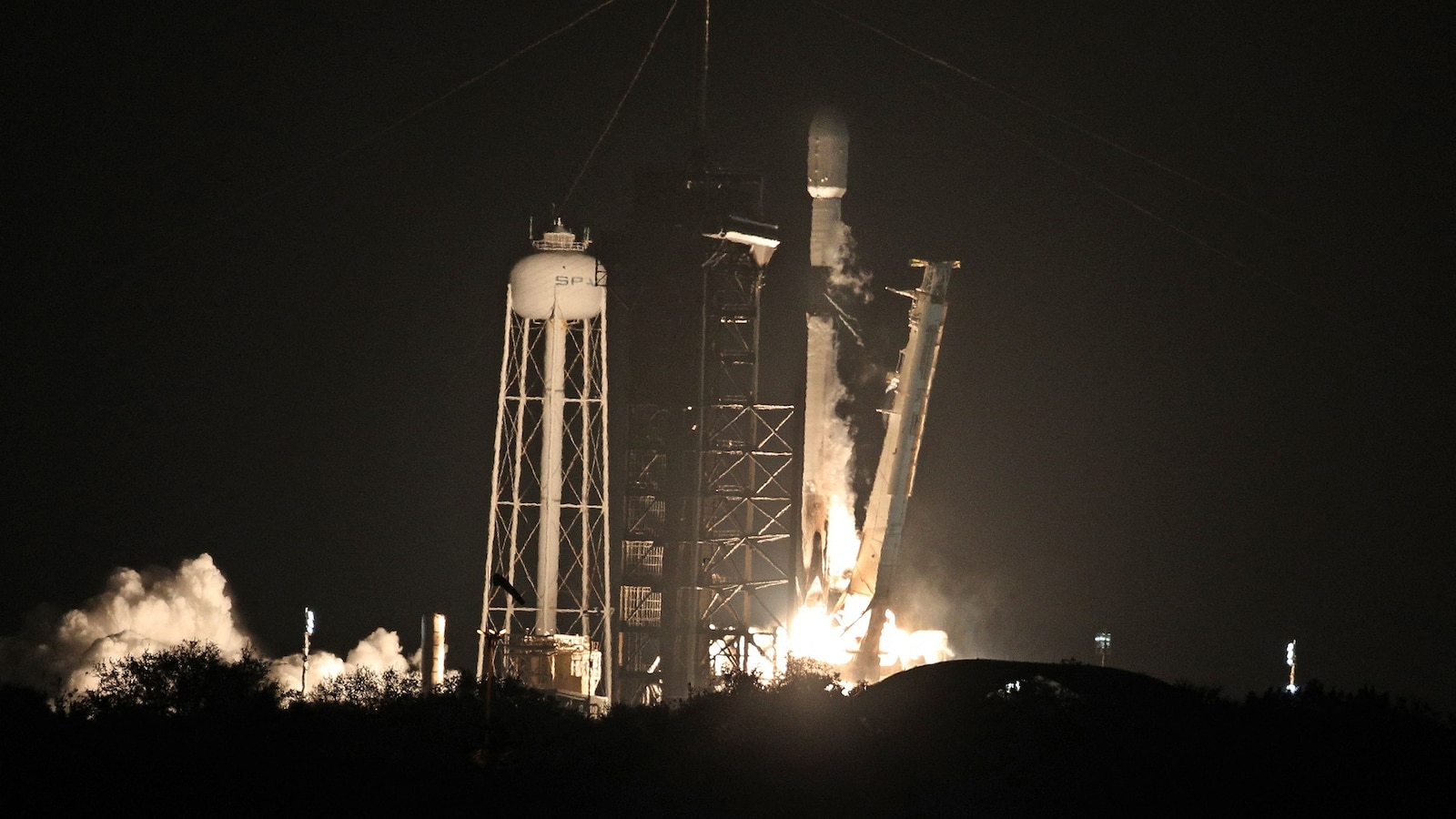
SpaceX Rocket Stage Set to Slam Into Moon
A SpaceX Rocket Booster Is About to Crash Into the Moon — And Scientists Are Excited!
What’s Happening?
Imagine throwing a heavy rock at a sandbox — you’d see dust fly up, a little crater form, and maybe a flash if it’s fast enough. Well, a 5-ton piece of a SpaceX rocket is about to do exactly that to the Moon — but it wasn’t planned!
On August 5, around 2:34 a.m. ET, the upper stage of a Falcon 9 rocket will slam into the Moon at 5,400 miles per hour near a crater called Einstein on the Moon’s western edge.
Important Point: This isn’t a mistake — it’s a happy accident for science!
Where Did This Rocket Come From?
Back on January 15, 2025, SpaceX launched a Falcon 9 carrying two lunar landers:
- Blue Ghost 1 (by Firefly Aerospace) — Landed successfully on March 2, 2025
- Resilience (by ispace) — Crashed 90 seconds before landing
After dropping them off, the rocket’s upper stage (the big top part) was left in a “moon-crossing high-Earth orbit” — meaning its path crosses the Moon’s orbit. Over time, the Moon’s gravity pulled it in… and now it’s on a collision course.
Why Are Scientists So Excited?
Usually, when space rocks hit the Moon, we don’t know:
- How big they were
- How fast they were going
- What they were made of
But this time? We know everything!
This Is a “Calibration Event”
Scientists can use this known impact to:
- Test their tools for studying natural impacts (which happen by surprise)
- Measure the flash, dust plume, and new crater to learn what the Moon’s surface is made of
- Understand risks for future astronauts and Moon bases
Important Point: NASA plans to send astronauts back to the Moon by 2028 and build a permanent base. Knowing how dangerous impacts are — from flying debris, blinding flashes, or dust clouds — is critical.
What Will Happen When It Hits?
According to Benjamin Fernando, lead researcher at Los Alamos National Laboratory:
- The booster will vaporize instantly
- A flash of light will burst out
- A plume of ejecta (Moon dust, rocks, regolith) will shoot up
- A fresh crater will be carved into the surface
Scientists hope to analyze that plume — if they can measure what’s in it, they learn what the Moon is made of in that spot.
Can You See It?
Short answer: Probably not with your eyes.
- The flash will be too faint for the naked eye
- It’s happening on the sunlit side of the Moon — making it even harder to see (no dark background)
- No impact flash has ever been recorded on the sunlit Moon before
But! Amateur astronomers with telescopes might catch it.
Want to Try?
Researchers are asking anyone with a telescope to watch and report what they see!
- Even a small telescope is worth pointing at the Moon
- Bigger telescope + dark skies + good timing = better chance
- You might see: a flash, a dust plume, or nothing at all — and that’s still useful data!
Important Point: Because this is so rare, scientists don’t know exactly what to expect — that’s why they need your eyes (and cameras)!
Did SpaceX Know This Would Happen?
We don’t know for sure.
Fernando says:
“I don’t think we know from SpaceX exactly to what degree they were in the know… Whether they knew and didn’t say anything, or simply hadn’t run the calculation, I couldn’t tell you.”
What we do know: The rocket was deliberately left in an orbit where a Moon impact was possible — but maybe not certain.
Summary
| What | Details |
|---|---|
| Object | Falcon 9 upper stage (~5 tons) |
| When | August 5, ~2:34 a.m. ET |
| Where | Near crater Einstein, western lunar limb |
| Speed | 5,400 mph |
| Why it matters | Known mass & speed = perfect “calibration event” for science |
| Science goals | Test impact models, study Moon composition, assess risks for future astronauts |
| Can you see it? | Only with a telescope — and even then, it’s a long shot |
| Your mission | If you have a scope, watch and report! |
FAQ
Will this crash damage the Moon?
Not really! The Moon gets hit by space rocks all the time. This is just a big, human-made one — and it’ll make a new crater, but the Moon’s used to it.
Could this hit a future Moon base?
It’s hitting a remote area (near crater Einstein), far from any planned landing sites. But studying it helps us design safer bases for the future.
Why not steer the rocket away?
Once the mission was done, the upper stage had no fuel left to maneuver. It was “abandoned” in orbit — standard practice for many rockets.
How do we know exactly when and where it’ll hit?
Astronomer Bill Gray (who runs Project Pluto) tracked it for months using orbital mechanics math — like predicting where a thrown ball will land, but in space.
What if I see something?
Report it! Scientists want every observation — even “I saw nothing.” Share photos, videos, or notes with the research team or astronomy groups online.
Final Thought: Space is full of surprises — and sometimes, our “space junk” becomes a gift to science. So if you’re up early on August 5… grab a telescope, look at the Moon, and help write a little piece of history.