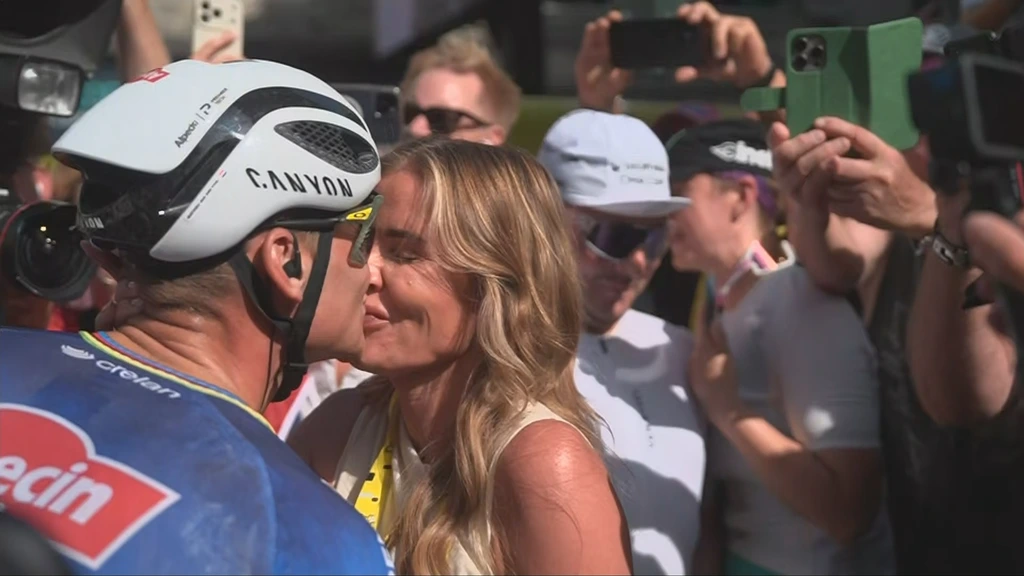
Van der Poel Stuns with 3rd Tour Win in Attack-Filled Spectacle!
What’s Happening in the Bike Race Right Now?
The Race in Simple Terms (ELI5)
Imagine a bike race is like a long running race on wheels. Sometimes, a few brave riders pedal super fast to get ahead of the big crowd. Right now, the race has split into three main bunches of riders (we call them "groups"). Let’s look at who is where!
Group 1: The Front Runners (Kopgroep)
This is the lead group, also called the breakaway. They are the furthest ahead in the race.
- Number of riders: 8
- The riders and their teams:
- Van der Poel (Alpecin-Premier Tech)
- Van Eetvelt (Lotto-Intermarché)
- Simmons (Lidl-Trek)
- Gee-West (Lidl-Trek)
- Castrillo (Movistar)
- Baudin (EF Education-Easypost)
- Tobias Johannessen (Uno-X)
- Pidcock (Pinarello-Q36.5)
Group 2: The Chasers (Achtervolgers)
These riders are behind the leaders, but they are pedaling hard to catch up!
- Time gap: They are 41 seconds behind the leaders (this is what "+0.41" means – 0 minutes and 41 seconds).
- Number of riders: 8
- The riders and their teams:
- Craps (Lotto-Intermarché)
- Izagirre (Cofidis)
- Costiou (Groupama-FdJ)
- Braz Afonso (Groupama-FdJ)
- Hirschi (Tudor)
- Jegat (TotalEnergies)
- Foss (Netcompany-Ineos)
- Valentin Paret-Peintre (Soudal-QuickStep)
Group 3: The Star Riders and Main Pack (Groep favorieten)
This is the big group that has most of the riders, including the super famous favorites who usually fight for the overall win.
- Time gap: They are 1 minute and 18 seconds behind the leaders (that’s "+1.18").
- Number of riders: 32
- Famous faces in this group include:
- Pogacar
- Vingegaard
- Evenepoel
- Pedersen
- Matthews
- (And many other riders!)
Important Point: The numbers like "+0.41" and "+1.18" are just a stopwatch difference! They tell us how much later these groups passed the same spot compared to the front group. The leaders are currently winning the race against the clock!
Summary
Right now, 8 brave riders are in the lead at the very front. Behind them, another 8 riders are chasing and are only 41 seconds back. The big group of 32 riders—including the biggest stars like Pogacar and Vingegaard—is a bit further back at 1 minute and 18 seconds. The race is still on, and anything can happen!
FAQ
Q1: What does "Kopgroep" mean?
A: "Kopgroep" is a Dutch word for the "lead group" or "breakaway." It’s the small bunch of riders at the very front of the race.
Q2: Why are there different groups in a bike race?
A: Some riders try to escape early to win the day’s stage, while the best overall riders (the favorites) often stay in the big group to save energy and keep an eye on their rivals.
Q3: What does "+1.18" mean for the favorites?
A: It means the favorites’ group is 1 minute and 18 seconds behind the lead group. In bike racing, that’s a small enough gap that they could still catch up later in the race!
Q4: Are the team names next to the riders important?
A: Yes! In professional bike racing, riders race for teams (like Alpecin-Premier Tech or Lidl-Trek). The team name tells us who employs and supports the rider during the race.