Maps Reveal Millions Under Scorching Heat Alerts in Plains, Northeast
The Giant Hot Lid: A Super Simple Story of the U.S. Heat Wave
What Is Happening Right Now?
Imagine a giant invisible bowl flipped over the United States, keeping hot air stuck underneath. That’s what’s going on!
- About 100 million people across the U.S. are facing extreme temperatures this week.
- A heat dome (a sky “lid” that traps hot air) started scorching the western part of the country and is now spreading to the Northeast.
- On Sunday, Billings, Montana hit a record 111°F. The dangerous heat was also felt across the Great Basin, the Rockies, and sections of the desert Southwest.
Maps Show the Latest Heat Wave
Weather maps from CBS News help us see the hot zones. Here’s the simple version:
- Temperatures are forecast to be 20 to 30 degrees hotter than normal for this time of year (said by CBS meteorologist Nikki Nolan).
- Some places will see record-breaking temperatures through the week.
- One map shows forecast high temperatures and heat alerts stretching from the Plains to the Northeast.
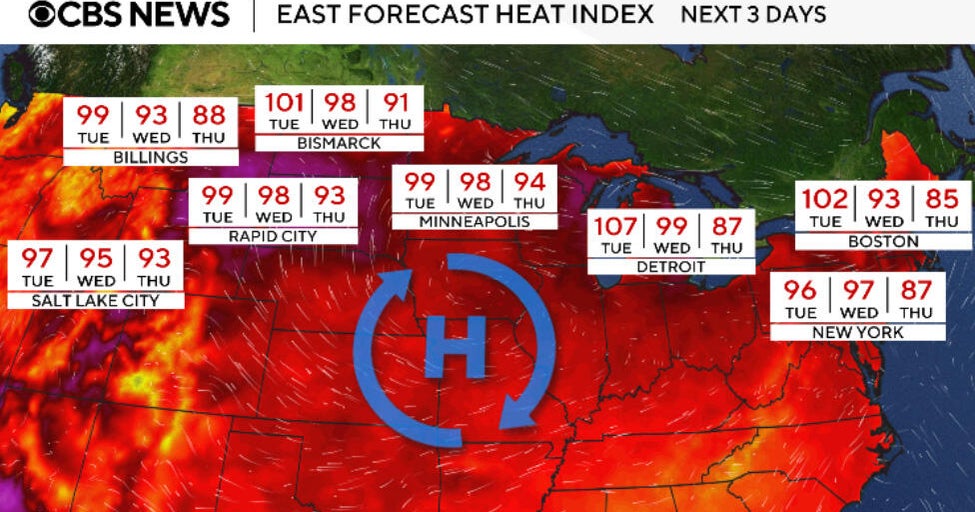
- Another map shows the heat index (how hot it feels with humidity) from the northern Plains through the Northeast.
- A 10‑day map shows areas forecast to see above‑normal temperatures in mid‑July 2026.
- A rain map shows heavy rain in the South through Wednesday, July 15, 2026.
- The hottest day (peak) for the Northern Tier is expected on Tuesday; for the Northeast, it’s Wednesday.
- The “heat index” will be in the high 90s to over 100 for many days.
IMPORTANT CALLOUT: Forecasters called this long bout of heat “exceptionally rare” for some locations, even in mid‑July. The National Weather Service says hazardous heat will spread eastward at times and linger in the central region through next weekend. Around 100 million people are affected—please take heat seriously!
Record Hot Spots and Warnings
- Salt Lake City reached an all‑time high of 109°F on Sunday. The old record was 107°F, last broken in 1960, 2002, 2021, and twice in 2022.
- Most of Utah was under an extreme heat warning until Tuesday morning.
- The Dakotas also had extreme heat warnings for large areas.
Why Is It So Hot? The Heat Dome Explained
A heat dome is just a fancy name for an atmospheric phenomenon that traps hot air over one place—like a lid on a pot.
How the hot lid formed (simple steps)
- Last week, the first summer heat wave began baking the western U.S.
- The heat dome built up in the West, keeping the hot air from escaping.
- Now forecasters say to brace for widespread highs between 105°F and 115°F, breaking many local records.
This heat brings two big dangers:
- Wildfire risk goes up.
- Heat‑related illnesses, including heat stroke, become more likely.
Important Quote from the Weather Service: “Extremely hot daytime highs combined with potentially record‑warm lows will result in increasing heat stress over the next several days due to limited relief.”
Heat Fuels Wildfires, Fires Up Thunderstorms
Hot weather dries things out and makes fires easier to start.
- In California, the Summit Fire in Antelope Valley forced some people near Los Angeles to evacuate. It burned nearly 3,000 acres. By Sunday evening, firefighters had it 31% contained.
- Extreme heat is expected in Southern California and Arizona through Thursday, with temperatures in the 90s and 100s (especially desert Southwest).
- Southern California may see record‑breaking overnight temperatures; the Southwest won’t likely break those records.
- In Colorado, two new wildfires sparked Sunday in the high country. Firefighters are still fighting the Aspen Acres Fire, which has burned over 850 structures, including hundreds of homes.
- Senator John Hickenlooper visited the damage and said the state needs more funding to battle wildfires because there have been “huge cuts to the fire service, to the BLM [Bureau of Land Management], there’ve been cuts everywhere.”
Rain and Flood Risk
While some areas bake, others get soaked.
- Heavy rain and flooding are worrying parts of the South.
- In Louisiana, thunderstorms dumped several inches of rain on New Orleans; families waded through knee‑high water.
- In Missouri, historic flash flooding on Saturday led to rescues: more than 200 people (including kids at a camp) were airlifted after 6–12 inches of rain fell in the southeast part of the state.
- Near Philadelphia, powerful microbursts (sudden strong wind gusts) up to 70 mph ripped through neighborhoods. Mayor Cherelle Parker signed a Disaster Emergency declaration on Sunday.
Summary
Let’s recap the big points:
- 100 million people are in extreme heat from a spreading heat dome.
- Record highs: Billings 111°F, Salt Lake City 109°F (old record 107°F set in 1960, 2002, 2021, twice 2022).
- Peak heat: Northern Tier Tuesday, Northeast Wednesday.
- Utah and Dakotas under extreme heat warnings; heat called “exceptionally rare.”
- Wildfires: Summit Fire (CA, 3,000 acres, 31% contained), Aspen Acres Fire (CO, 850+ structures), new Colorado fires.
- Flooding/heavy rain in Louisiana, Missouri; wind damage near Philadelphia.
- Original reporting by Carter Evans, Nikki Nolan, and Andrew Kozak for CBS News.
FAQ
Q1: What is a heat dome in kid words?
A: It’s like a giant invisible lid in the sky that traps hot air over a place, so it stays super hot for days.
Q2: Why was Salt Lake City’s temperature special?
A: It hit 109°F, the hottest ever recorded there. The previous record was 107°F, last equaled in 1960, 2002, 2021, and twice in 2022.
Q3: How does heat make people sick?
A: The article warns of heat‑related illnesses like heat stroke, which happens when the body overheats because the air stays too hot day and night.
Q4: Are there other dangers besides the heat itself?
A: Yes! The heat helps spawn wildfires (California, Colorado) and also weird storms: floods in the South and strong microburst winds in Philadelphia.
Q5: Who gave us this information?
A: The original CBS News report was contributed to by Carter Evans, Nikki Nolan, and Andrew Kozak.