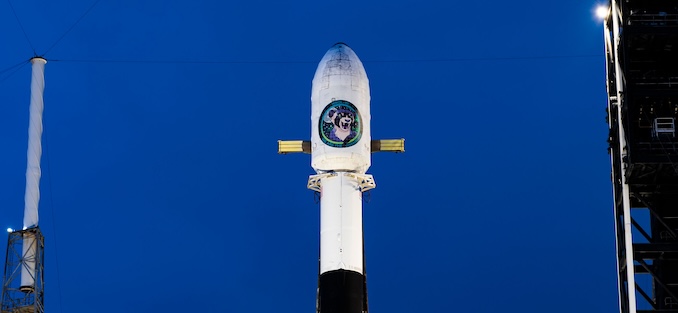
TOP SECRET: Watch SpaceX Launch Classified NRO Mission Live Now
SpaceX Falcon 9 Launches Secret Spy Satellite for U.S. Intelligence Agency
Quick Summary: A SpaceX Falcon 9 rocket blasted off from Florida early Thursday morning carrying a top-secret payload for the National Reconnaissance Office (NRO). The mission, called NROL-95, marked the 7th flight for this particular booster and aimed for a landing back at Cape Canaveral.
What Happened?
In the predawn hours of Thursday, July 30, 2026, a SpaceX Falcon 9 rocket lifted off from Space Launch Complex 40 at Cape Canaveral Space Force Station in Florida. The rocket carried a classified payload for the National Reconnaissance Office (NRO) — the U.S. government agency in charge of designing, building, and operating America’s spy satellites.
Mission Details at a Glance
| Detail | Information |
|---|---|
| Mission Name | NROL-95 |
| Rocket | SpaceX Falcon 9 |
| Launch Site | Cape Canaveral Space Force Station, SLC-40 |
| Launch Time | 3:10 a.m. EDT (0710 UTC) |
| Payload | Classified (NRO) |
| Booster | B1096 (7th flight) |
| Landing Site | Landing Zone 2 (Cape Canaveral) |
| Weather Odds | 70% favorable |
Important Points to Remember
KEY TAKEAWAYS
- This was the third NRO mission launched on a Falcon 9 under the National Security Space Launch Phase 2 contract
- The contract is managed by the U.S. Space Force’s Space Systems Command
- SpaceX won the task order for this mission in August 2024
- The booster (B1096) has now flown 7 times — including NASA science missions, GPS satellites, and Starlink launches
- If the landing succeeds, it will be the 18th touchdown at Landing Zone 2 and the 642nd overall booster recovery for SpaceX
How the Launch Went Down (Step by Step)
- Countdown & Final Checks — SpaceX adjusted the exact liftoff time (T-0) early Thursday morning
- Liftoff — Falcon 9 roared off the pad at 3:10 a.m. EDT
- Stage Separation — The first stage (booster B1096) separated from the upper stage
- Boostback & Landing Burn — The booster flipped around, flew back toward Cape Canaveral, and targeted Landing Zone 2
- Touchdown — ~8.5 minutes after launch, the booster aimed to stick the landing
- Payload Deployment — The upper stage continued to orbit to deploy the classified NRO satellite(s)
Weather Watch
The 45th Weather Squadron gave a 70% chance of acceptable conditions. However, forecasters kept an eye on:
- Cloud cover — Could interfere with launch visibility rules
- Thunderstorms — Overnight storm remnants posed a lingering threat
Quote from Launch Weather Officers:
"Significant weather model ambiguity remains regarding the longevity, extent and location of remnant storms and associated cloud cover during the overnight periods… albeit with still a decent potential for acceptable weather."
Why This Mission Matters
- National Security: The NRO operates the nation’s reconnaissance satellites — "eyes in the sky" for intelligence gathering
- Reusable Rockets: SpaceX continues proving rapid reusability — this booster’s 7th flight in a short span
- Government Partnership: Strengthens SpaceX’s role as a trusted launch provider for sensitive U.S. government payloads
- Launch Cadence: Another example of the high launch tempo from the Space Coast
Watch the Replay
Spaceflight Now provided live coverage starting about 1 hour before liftoff. You can catch the full webcast here:
Watch the NROL-95 Launch Replay on YouTube
Summary
Early Thursday morning, SpaceX successfully launched the NROL-95 mission for the National Reconnaissance Office from Cape Canaveral. The Falcon 9 booster B1096 completed its 7th flight and returned to Landing Zone 2 for a precision touchdown — marking the 18th landing at that site and the 642nd booster recovery overall. The mission was the third NRO launch on Falcon 9 under the National Security Space Launch Phase 2 contract, awarded to SpaceX in August 2024. Despite a 70% weather forecast with some storm concerns, the launch proceeded on schedule at 3:10 a.m. EDT.
FAQ
Q: What is the NRO?
A: The National Reconnaissance Office is a U.S. intelligence agency that designs, builds, and operates the nation’s spy satellites. Their satellites provide critical intelligence for national security, disaster response, and more.
Q: Why is the payload "classified"?
A: The exact capabilities, orbit, and purpose of NRO satellites are top secret to protect national security. Revealing details could help adversaries avoid detection or counter U.S. intelligence efforts.
Q: How many times has this booster flown before?
A: This was the 7th flight for booster B1096. Its previous missions included NASA’s IMAP and CRS-34, a Kuiper satellite launch, NROL-77, GPS III-9, and a Starlink mission (Starlink 6-87).
Q: Where did the booster land?
A: The booster targeted Landing Zone 2 (LZ-2) at Cape Canaveral Space Force Station — a concrete landing pad just a few miles from the launch pad. It aimed to land about 8.5 minutes after liftoff.
Q: What is the National Security Space Launch (NSSL) Phase 2 contract?
A: It’s a U.S. Space Force program to launch military and intelligence satellites. SpaceX and United Launch Alliance (ULA) are the two providers. This NROL-95 mission was the third NRO launch awarded to SpaceX under this contract.