US Atom Smasher Could Finally Crack the Code of Matter
The Electron-Ion Collider: A Giant Microscope for the Tiniest Building Blocks of Nature
What Is This All About?
Imagine you have a magic magnifying glass. You look at a brick wall, then zoom in to see the bricks. Zoom in more, and you see the clay grains. Zoom in even more, and you see molecules, then atoms. For centuries, scientists have been building better and better "magnifying glasses" to see what makes up our world.
But here is the big mystery: We still don’t fully know what happens inside the heart of an atom.
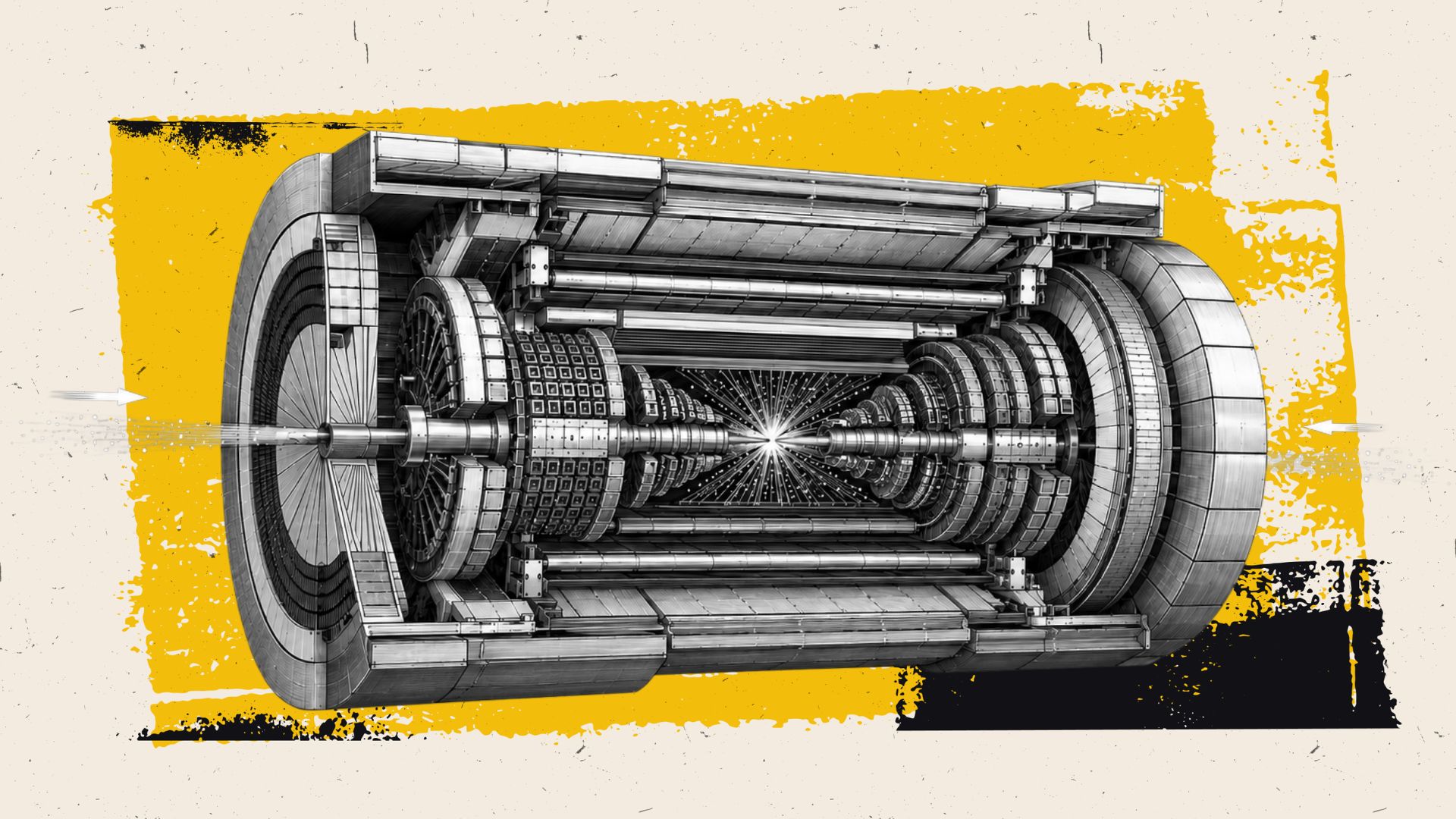
To solve this, scientists are building a brand-new, incredibly powerful machine called the Electron-Ion Collider (EIC). Think of it as the ultimate 3D scanner for the tiniest particles in existence.
Where Is It Being Built?
Location: Brookhaven National Laboratory (BNL) in Upton, New York, USA.
This isn’t just any science lab—it is one of the world’s most ambitious particle physics projects ever attempted.
How Does It Work? (The Simple Version)
You know how a CT scan at the hospital takes thousands of X-ray pictures from different angles to build a detailed 3D image of your insides?
The EIC does something very similar, but for protons and atomic nuclei (the heavy centers of atoms).
The Basic Recipe:
- The Ingredients: Take a beam of electrons (tiny, negatively charged particles) and a beam of protons or atomic nuclei (the heavy, positively charged centers of atoms).
- The Race Track: Speed them up to nearly the speed of light inside a 2.4-mile (3.8 km) underground ring.
- The Crash: Smash the electron beam head-on into the proton/nuclei beam.
- The Snapshots: Detectors surrounding the crash site record exactly how the particles scatter and what new particles fly out.
- The Reconstruction: Computers piece together millions of these "snapshots" to build a precise 3D map of the inside of a proton.
Key Insight: Electrons are perfect for this because they are fundamental particles (they aren’t made of anything smaller). They act like clean, precise probes that bounce off the "stuff" inside protons without getting messy themselves.
Why Is This Such a Big Deal?
You might ask: "Haven’t we smashed atoms before?" Yes, but the EIC is special for three huge reasons:
1. It’s a "CT Scan," Not Just a Hammer
Older colliders (like the LHC at CERN) often smash two protons together. That’s like smashing two watches together to see how they work—you get a mess of gears and springs. The EIC shoots a point-like electron at a proton. It’s a clean probe hitting a complex target, giving a much clearer picture.
2. It Unlocks the "Glue" of the Universe
Protons are made of quarks held together by gluons (the "glue" particles).
- The Mystery: Gluons carry the Strong Force—the strongest force in nature. It binds quarks into protons, and protons into nuclei.
- The Goal: The EIC will finally let us see how gluons are distributed inside a proton and how they create the proton’s mass and spin.
3. It Explores a New Phase of Matter
When you smash electrons into heavy nuclei (like gold) at high energies, you might create a state of matter called the Color Glass Condensate—a wall of gluons so dense it saturates. This likely existed microseconds after the Big Bang. The EIC is the only machine designed to find it.
What Will We Learn? (The "So What?" Factor)
Understanding the inside of a proton isn’t just academic stamp collecting. It touches the foundations of reality:
- Origin of Mass: The Higgs field gives mass to electrons and quarks, but 99% of your mass comes from the energy of gluons zipping around inside protons (E=mc² in action!). The EIC will explain how.
- Proton Spin: Protons spin like tiny tops. This spin is used in MRI machines every day to save lives. Weirdly, the quarks only provide ~30% of that spin. Where is the rest? Gluons? Orbital motion? The EIC will find out.
- Fundamental Physics: Precision data from the EIC helps physicists test the Standard Model (our best theory of particles) to its breaking point, potentially revealing new physics.
Timeline: When Can We See Pictures?
Building a machine this complex takes time. Here is the roadmap:
- Design & R&D (Ongoing): Finalizing detector designs, testing new accelerator technologies.
- Construction (Early 2020s – Early 2030s): Building the electron storage ring, upgrading the existing ion ring (RHIC), and assembling massive detectors.
- Commissioning (~Early 2030s): Turning it on, tuning the beams, calibrating detectors.
- Science Runs (Mid 2030s+): Decades of data-taking and discovery begin!
Summary
- The Goal: See the 3D internal structure of protons and atomic nuclei with unprecedented detail.
- The Machine: The Electron-Ion Collider (EIC) at Brookhaven National Lab (New York).
- The Method: Collide polarized electrons with polarized protons/ions at high energy/luminosity (like a high-res CT scan).
- The Big Questions: How do gluons create mass? Where does proton spin come from? What does saturated gluon matter look like?
- The Impact: Fundamental understanding of the Strong Force, the origin of visible mass, and the early universe.
FAQ: Your Questions Answered
Is the EIC the same as the Large Hadron Collider (LHC)?
No. The LHC (at CERN) mostly smashes proton-proton or lead-lead to find new heavy particles (like the Higgs boson). The EIC smashes electron-proton/ion to take high-precision pictures of the structure of known particles. They are complementary tools.
Why use electrons? Why not just smash protons together?
Electrons are fundamental point particles with no internal structure. When they hit a proton, the interaction is clean and calculable (via Quantum Electrodynamics). Proton-proton collisions are messy "pile-ups" where the internal structure of both protons complicates the picture.
Is it dangerous? Could it create a black hole?
Absolutely not. The energies per particle collision are high for a microscope, but tiny compared to cosmic rays hitting Earth’s atmosphere every second naturally. Nature has been running this experiment for billions of years; we are just building a detector to watch it happen in a controlled lab.
What does "Polarized" mean in this context?
It means the spins of the electrons and protons/ions are aligned in a specific direction (like tiny magnets all pointing "Up"). This is crucial! It allows scientists to tease out exactly how the spins of quarks and gluons add up to the proton’s total spin.
Who pays for this?
It is a major U.S. Department of Energy (DOE) project, hosted by Brookhaven National Lab, with significant international collaboration (hundreds of scientists from dozens of countries contributing detectors and expertise).