11
11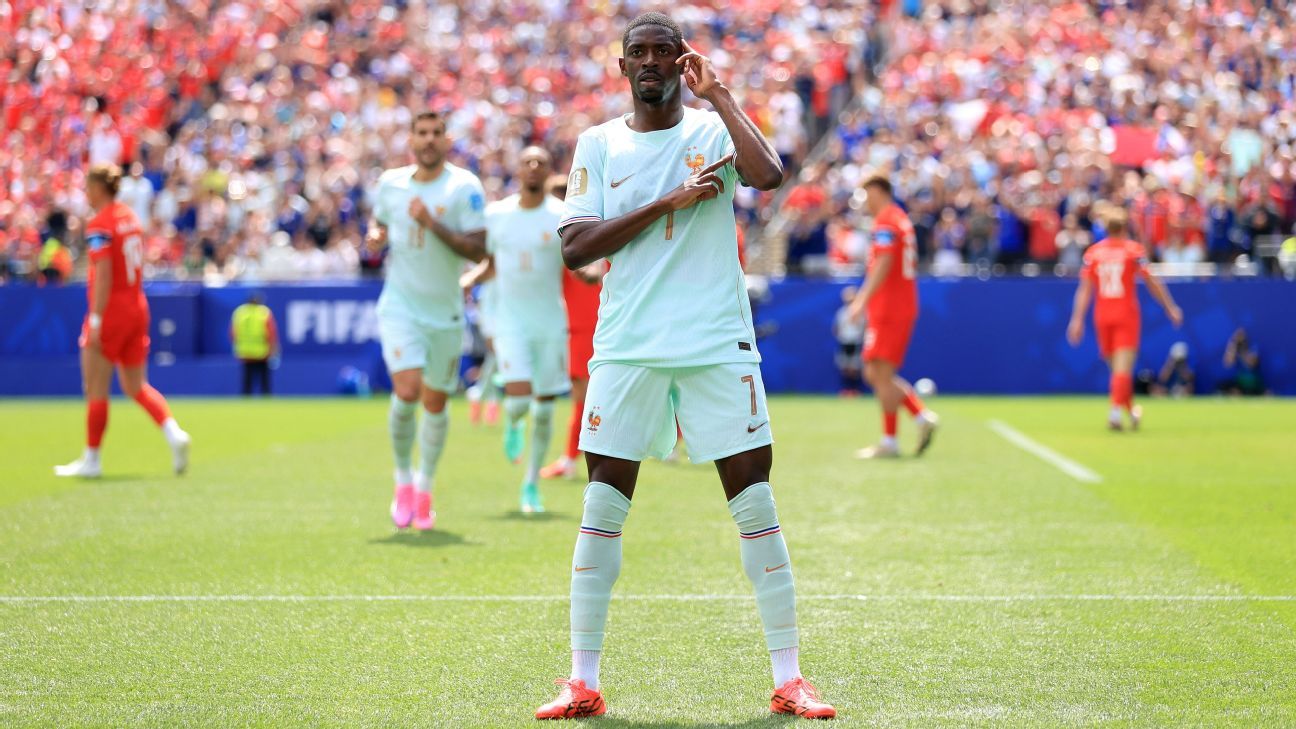
Okay, let’s start with the basics. A hat trick in soccer means one player scores three goals in a single game. It’s rare. Really rare. In fact, most professional soccer players go their entire career without ever doing one — especially at the World Cup, the biggest tournament on the planet.
Think of it this way: imagine you’re playing basketball, and in one game, you score three times as many points as you normally do. That’s kind of what a hat trick feels like in soccer. It’s special. It’s memorable. And when it happens on the World Cup stage, it becomes legendary.
Some of the greatest players in history — Diego Maradona, the original Ronaldo (R9), Neymar, Thierry Henry, and Johan Cruyff — never scored a World Cup hat trick. Let that sink in for a moment.
Before this story unfolds, only two French players had ever scored a hat trick at a World Cup:
That’s it. In all of French football history, spanning decades and decades, only two names. And now, a third name joins that exclusive club.
Here’s something that might surprise you: before his incredible performance, Ousmane Dembélé had never even scored two goals (a "brace") in 61 appearances for the French national team. Sixty-one games! That’s a lot of matches without finding the back of the net more than once.
And it wasn’t like he was a bad player. Far from it. He is:
So why wasn’t he performing for France the way he did for his club? That was the million-dollar question everyone in France was asking.
Before the Norway game, the conversation around Dembélé was negative. French media and fans were wondering:
Dembélé was often described as looking "laborious" — meaning he seemed to be working hard but not making things happen — when wearing the French national team jersey. Aside from a few bright moments, he had never been decisive (meaning he didn’t make a game-changing impact) in a major tournament like the World Cup or the European Championship, even though he’d been playing for France for almost ten years.
Here’s the thing most people didn’t see: Dembélé wasn’t panicking. Privately, he was still one of the leaders in the squad — the heart and soul of the team. But on the pitch, he seemed stuck, playing in the shadows of his more flashy teammates, Kylian Mbappé and Michael Olise.
He told the people close to him that he knew his turning point would come. Still, the constant criticism from the French media bothered him more than usual this time. He doesn’t typically let outside noise get to him, but this time, it rattled him a little.
Last Friday, France faced Norway in a World Cup match. And Dembélé did something extraordinary:
He scored a hat trick — three goals — in just 25 minutes!
This was the second-fastest hat trick in World Cup history. France won the game 4-1, and Dembélé was the undisputed star.
After his first goal, Dembélé ran to the press box — the area where journalists and reporters sit — and made a gesture with his right hand that clearly meant: "Shut your mouths."
He was firing back at every critic who had questioned him. And he wasn’t the first French player to do this:
Though those situations were far more toxic than what Dembélé faced, the PSG winger was still hurt by the constant negativity surrounding him.
After the game, the scene in the dressing room was electric:
When he faced the media afterward, he wasn’t interested in giving clever soundbites. To six different questions, he gave the same answer:
"We have to stay focused!"
He was clearly in no mood to play games with reporters. He even went on to say he "preferred his performance against Senegal" — a game where he didn’t score. Why? Because he believed his role for France wasn’t just about goals and assists. It was about his overall activity on the pitch: pressing, creating space, making runs, and helping the team in every way possible.
Samuel Umtiti, a former French defender who won the 2018 World Cup alongside Dembélé, explained it perfectly:
"He will never be with France like he is with PSG. They are two different teams with two different styles of football where he plays in two different positions."
In plain English: PSG builds their entire attack around Dembélé. He’s the main guy. But France already had Mbappé and Olise as the stars. Dembélé had to adapt to a different system, a different position, and a different role — and that’s not easy, even for the best player in the world.
France’s head coach, Didier Deschamps, had long one-on-one discussions with Dembélé about the situation. Here’s how the coaching staff worked through it:
France now faces Sweden on Tuesday in New Jersey in the Round of 32. If Scandinavians inspire Dembélé the way Norway did, Swedish defenders should be very, very worried.
The story of Dembélé at this World Cup is a reminder that even the best players in the world need time, patience, and the right environment to shine — especially when they’re playing for their country.
Q1: What is a hat trick in soccer?
A hat trick is when a single player scores three goals in one game. It’s a rare and celebrated achievement, especially at the World Cup.
Q2: Why was Dembélé struggling for France when he was so good for PSG?
Because France and PSG are two completely different teams with different styles and systems. At PSG, the entire attack is built around Dembélé. At France, he had to adapt to playing alongside other superstars like Mbappé and Olise in a different role and position.
Q3: How fast was Dembélé’s hat trick against Norway?
He scored all three goals in just 25 minutes, making it the second-fastest hat trick in World Cup history.
Q4: What did Dembélé’s goal celebration mean?
After his first goal, he made a gesture toward the press box that meant "shut your mouths" — a direct response to all the critics and media members who had been questioning his performances for France.
Q5: Who are the other French players who scored World Cup hat tricks?
Before Dembélé, only Just Fontaine (1958) and Kylian Mbappé (2022) had achieved this feat for France.