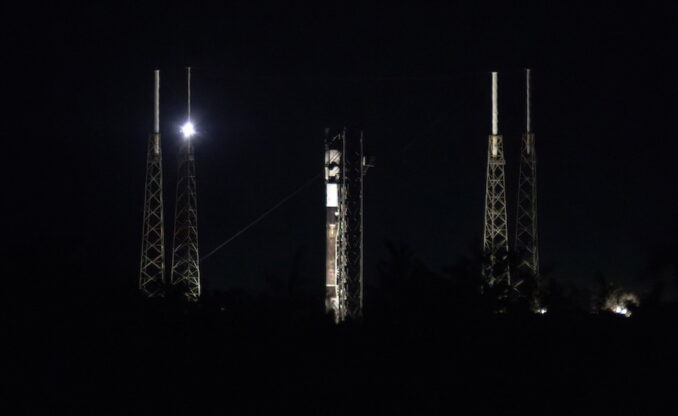
Live: SpaceX hits 600th flight-proven Falcon booster launch
SpaceX is Launching Internet Satellites Using a Rocket Part for the 600th Time!
What’s the Big News?
SpaceX (a space company) is getting ready to send more internet satellites into space. They will use a special rocket part that has flown many times before. In fact, this will be the 600th time they are reusing one of these parts!
Important Point: Reusing rocket parts is like using the same bicycle for many rides instead of buying a new one each time. It saves money and helps the environment.
The mission is called Starlink 10-45. It will launch from a place called Cape Canaveral Space Force Station on Tuesday morning (very early, before the sun is fully up).
What Will the Rocket Carry?
The rocket will take 29 small internet satellites into space. These satellites are like tiny space computers that help people on Earth get fast internet.
- SpaceX already has a huge group (called a "constellation") of these satellites.
- They have more than 10,7000 (that’s over ten thousand!) spacecraft flying around Earth in a low path called "low Earth orbit" (think of it as a circle not too far above your head).
When and Where Will It Launch?
- Place: Space Launch Complex 40 (we can call it SLC-40), which is a special pad at Cape Canaveral.
- Time: Planned for 5:10 a.m. EDT (that’s 9:10 UTC).
- Direction: After leaving the pad, the rocket will fly toward the north-east.
Important Update: On July 13 at 4:12 p.m. EDT (2012 UTC), SpaceX said they pushed back the exact liftoff time (called "T-0"). So the time might change a little, but the plan above is the latest schedule.
Spaceflight Now (a website that watches space launches) will show live video about one hour before the rocket leaves the ground. You can watch it on their YouTube stream: Live Coverage.
The Rocket and Its Special Booster
The rocket is a Falcon 9 made by SpaceX. The bottom part that pushes the rocket up is called the first stage booster. This one has a tail number (like a license plate): B1080.
- This booster has flown 27 times before (so this will be its 28th trip!).
- In the past, it helped launch:
- Two crew flights for a company called Axiom Space (those carried people).
- A space observatory for the European Space Agency called Euclid.
- A cargo mission for Northrop Grumman (NG-21).
Step-by-Step of the Launch (Simplified)
Here is what will happen in order:
- Liftoff: The rocket fires its engines and leaves the pad at SLC-40.
- Fly Northeast: It heads over the ocean in a north-easterly direction.
- Satellite Release: After a while, the 29 Starlink satellites will be dropped off in space.
- Booster Turnaround: About 8.5 minutes after launch, the booster (B1080) will try to land on a floating robot boat in the Atlantic Ocean.
- Landing Success: If it works, this will be the 161st time this boat catches a booster, and the 638th total landing for SpaceX.
Weather Watch
Weather experts (the 45th Weather Squadron) looked at the sky and said:
- At the start of the launch window, there is a 90% chance the weather is good.
- As time passes, it gets even better: 95% chance.
- They are watching for thick clouds left from last night’s storms. These clouds might cause lightning if the rocket flies through them.
Important Point: Launch weather officers said: "Some lingering thick clouds left over by the evening convection may be present at the beginning of the launch window but should gradually dissipate through the window. As a result, we have raised the POV slightly at the beginning of tonight’s launch window, but overall good weather is expected."
POV means "Probability of Violation" – basically the chance they break a safety rule about clouds and lightning.
Summary
To wrap up:
- SpaceX will launch Starlink 10-45 on a Falcon 9 from Cape Canaveral at about 5:10 a.m. EDT Tuesday.
- This uses a reused booster (B1080) for the 600th reuse ever.
- 29 internet satellites will join the growing group in low Earth orbit.
- The booster will try to land on a droneship named "A Shortfall of Gravitas" in the Atlantic.
- Weather looks mostly friendly for the rocket, with a tiny cloud worry.
- Live coverage is available on Spaceflight Now about an hour before liftoff.
FAQ (Simple Questions and Answers)
Q1: What is a booster and why reuse it?
A: A booster is the bottom part of a rocket that gives the initial push. Reusing it is like recycling: you fix it and fly again, saving money.
Q2: What is Starlink?
A: Starlink is SpaceX’s project of many small satellites that work together to provide internet from space to your home.
Q3: What is a droneship?
A: It’s a robotic ship with no people on board that waits in the ocean to catch the falling booster with its deck, like a floating landing pad.
Q4: Why do they launch so early in the morning?
A: The schedule depends on where the satellites need to go and weather; predawn launches are common for these missions.
Q5: What does "T-0" mean?
A: T-0 is the exact moment of liftoff. When they say "pushed back T-0," they mean the launch time was moved later.