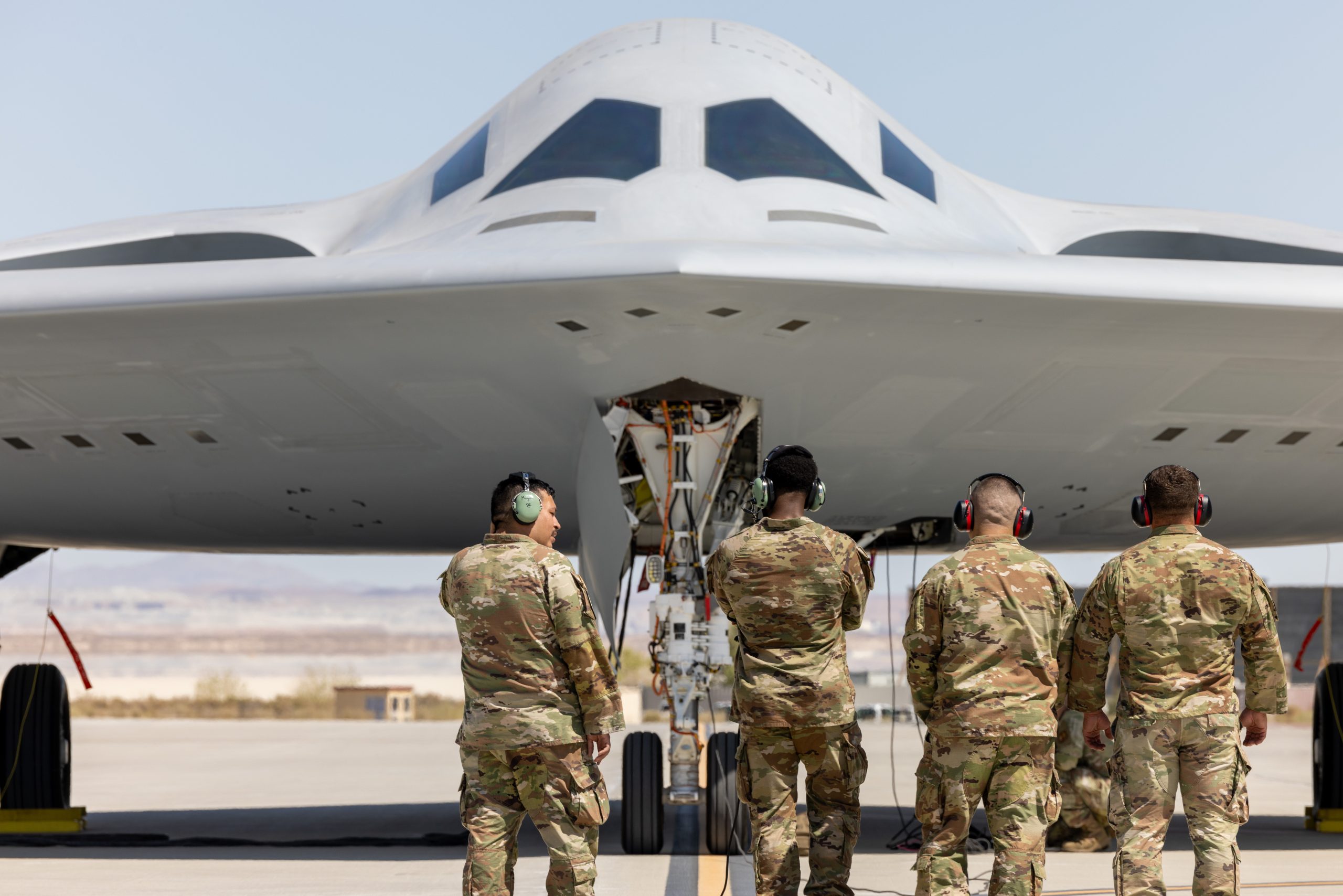
Air Force to Train WSOs to Pilot Stealth B-21 Raiders
The Air Force’s New Stealth Bomber: The B-21 Raider and Its Two-Pilot Crew
What Is the B-21 Raider?
Imagine a giant airplane that is built to be almost invisible to enemy radar—like a sneaky flying wing. That’s the B-21 Raider, a next-generation stealth bomber made by a company called Northrop Grumman.
- It has a “flying wing” shape (like the older B-2 bomber) with no tail.
- It can carry both conventional (normal) bombs and nuclear weapons.
- The Air Force plans to start using it in 2027.
- Official plans call for at least 100 of these bombers, but leaders say the number might grow to 145 or more.
A Big Decision: Two Pilots in the Cockpit
The Air Force has officially decided the B-21 will fly with two pilots on board. Some of those pilots will actually be officers who used to do different jobs—called Weapon System Officers (WSOs) and Combat Systems Officers (CSOs).
Important: At one point, people thought the B-21 might fly with only one pilot and one weapon systems officer. Last fall, Defense Daily and Aviation Week reported that Gen. Thomas A. Bussiere (then head of Air Force Global Strike Command) had recommended that setup. But the Air Force chose two pilots instead.
Why Two Pilots? Long Missions Need Rest
Bombers often fly extremely long trips. For example, during a mission called Operation Epic Fury, older bombers (the B-1B Lancer and B-2A Spirit) flew 37-hour round trips from the U.S. to Iran and back. Those older planes have two pilots who take turns sleeping and resting. A single pilot couldn’t safely handle such a marathon flight.
Test Planes and Future Bases
The first two “production-representative” B-21s (test versions that look just like the real thing) are already flying at Edwards Air Force Base in California. At least one of these will move to Ellsworth Air Force Base in South Dakota in early 2027, when the first operational B-21 unit is formed.
How Many Pilots Will Be Needed?
An Air Force spokesperson says they are still figuring out the exact number of B-21 pilots required. Here’s what we know from the end of 2025:
- There were 497 personnel with the bomber pilot job code (called “11B” Air Force Specialty Code, or AFSC—think of it as a badge that says “bomber pilot”).
- There were 141 bombers in total.
- That’s a ratio of about 3.5 pilots per plane.
- All current Air Force bombers use two pilots per crew, and the B-21 will use the same “11B” code.
Important: If the Air Force keeps the same ratio, they will ultimately need at least 350 B-21 pilots.
Where Will the New Pilots Come From?
The Air Force is creating a transition program to turn experienced WSOs and CSOs into B-21 pilots.
What Are WSOs and CSOs? (Explained Simply)
- WSO (Weapon Systems Officer): A crew member who operates the plane’s weapons, helps the pilot understand the surroundings, and runs defensive systems. They come from the B-1, B-52, and F-15E communities.
- CSO (Combat Systems Officer): Similar to a WSO, but they can also act as mission commanders for electronic warfare (tricking enemy sensors) and navigation.
Earlier, the Air Force thought they’d retire the B-1 and B-2 sooner, and those pilots would switch to the B-21. But both older bombers will now stay for about another decade. Tapping WSOs and CSOs is a fast way to build a pilot force—and it keeps talented folks from leaving as planes like the F-15E are retired.
Important: The Air Force stated: “To maximize the lethality and survivability of the Raider, it is imperative to retain the deep tactical and combat experience currently residing within the WSO and CSO communities.” In plain English: Keeping these experts makes the bomber stronger and safer for long, dangerous missions.
A Note on Other Jets
- The B-1 is planned to retire in the late 2030s.
- The Air Force wanted to retire over half the F-15E fleet, but Congress blocked that so far.
- The newer F-15EX will replace the F-15E; it has two seats but can be flown by a single pilot (that’s the current plan).
Eligible WSOs and CSOs will get more details through their normal command channels.
Step-by-Step: How WSOs and CSOs Become B-21 Pilots
While full details come later, here’s the basic path:
- Be an eligible WSO or CSO from the B-1, B-52, or F-15E communities.
- Be selected or volunteer for the special transition program.
- Train to become a pilot and earn the “11B” bomber pilot job code.
- Take a follow-on assignment flying the new B-21 bomber.
- Receive further instructions from regular Air Force command channels.
Summary
The B-21 Raider is a new stealth bomber that will enter service in 2027 with a two-pilot crew. This choice avoids the dangers of ultra-long missions (like 37-hour flights) where pilots need to rest. To staff the planes, the Air Force will train former weapon and combat systems officers (WSOs and CSOs) as pilots, preserving their valuable experience. The first test bombers are flying now, at least 100 (maybe 145+) will be built, and around 350 pilots will be needed based on today’s ratios. It’s a smart plan to keep the Air Force ready for tough, far-away missions.
FAQ
Q1: What is a stealth bomber?
A: It’s an airplane shaped and coated to avoid enemy radar—like an invisible flying wing that can deliver bombs, including nuclear ones.
Q2: Why didn’t the Air Force go with one pilot and one WSO?
A: Because bombing missions can last over 30 hours. Two pilots can switch off sleeping so nobody gets too tired to fly safely.
Q3: What’s the difference between a WSO and a CSO?
A: Both handle weapons and sensors, but a CSO can also lead the mission for electronic warfare and navigation, acting as the mission commander.
Q4: When and where will the first B-21 unit appear?
A: Early 2027 at Ellsworth Air Force Base in South Dakota, using one of the test planes from Edwards AFB.
Q5: How many B-21s will the Air Force buy?
A: At least 100, but Pentagon leaders hint the fleet could grow to 145 or more.