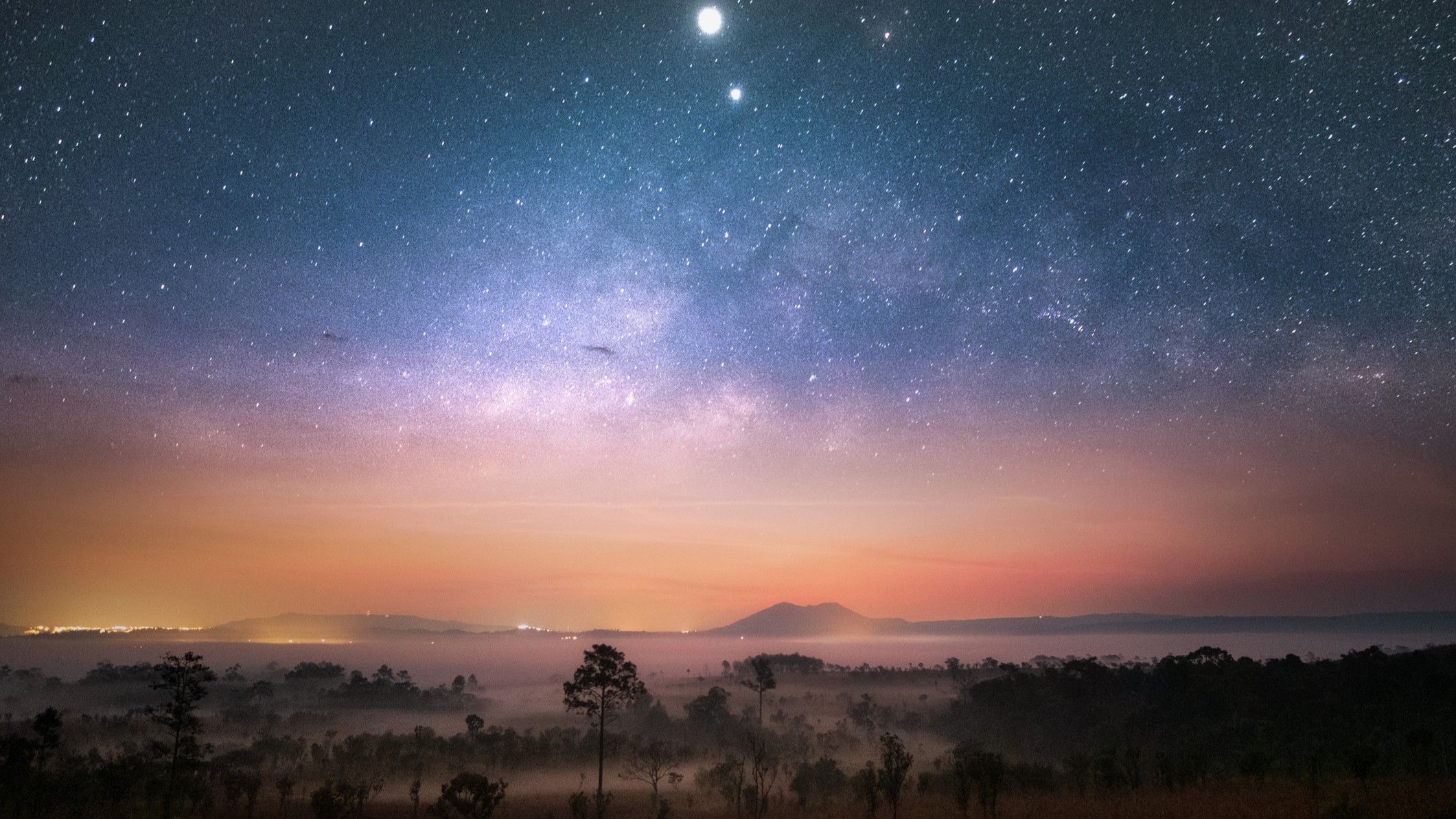
August Planet Parade: 5 Worlds Visible Now — Don’t Miss It
August Night Sky Guide: Your Front-Row Seat to Planetary Meet-Ups
Welcome to your monthly sky-watching cheat sheet! Think of the solar system like a giant cosmic dance floor. This August, the planets are pairing up, showing off their best angles, and putting on a show you won’t want to miss—no telescope required (though binoculars help!).
Quick Overview: What’s Up This Month?
- Venus is the super-bright "Evening Star" you can’t miss after sunset.
- Mercury & Jupiter snuggle up close in the early morning twilight around mid-month—a rare "planetary hug."
- Saturn is the star of the show if you do have a telescope (hello, rings!).
- Mars rises late at night, glowing orange and getting steadily brighter.
- Pro tip: Your own fist is a built-in sky ruler (more on that below).
Your Handy Sky-Measuring Tool: The "Fist Rule"
IMPORTANT: How to Measure the Sky Without Fancy Gear
Hold your arm out straight and make a fist. The width of your fist covers about 10° of sky.
- 1 finger ≈ 1°
- 3 middle fingers ≈ 5°
- Clenched fist ≈ 10°
Use this to judge how high a planet is or how far apart two objects appear. It works for everyone—kids and adults alike!
Planet-by-Planet Viewing Guide
1. Venus – The Dazzling Evening Star
- When: Right after sunset, all month long.
- Where: Low in the west-southwest.
- Cool fact: On Aug 15, Venus hits its greatest elongation—farthest from the Sun in our sky (46°). But here’s the twist: instead of climbing higher, it’s actually sinking lower each night!
Why? The "ecliptic" (the planets’ highway across the sky) tilts low toward the horizon in late summer. So Venus slides sideways along that ramp, dropping toward the sunset glow. - Bonus: On Aug 15, a thin crescent Moon sits to Venus’s lower right—perfect photo op!
- Through a telescope: Venus looks like a tiny half-moon (about 48% lit).
2. Mercury & Jupiter – The Dawn Duo
Early birds get the best view this month.
| Date | What’s Happening |
|---|---|
| Aug 2 | Mercury at greatest elongation (19° from Sun). Look 50 min before sunrise, low in east-northeast. Brightness: magnitude +0.2. |
| Aug 9 | Mercury brightens to -0.7 mag (brighter than most stars). Castor & Pollux (Gemini’s "Twin Stars") point straight down to it—just extend the line between them twice the distance. |
| Aug 11 | Ultra-thin crescent Moon (only 2% lit!) sits 2° above Mercury. Challenge: spot them both in bright twilight! |
| Aug 13–17 | Mercury & Jupiter dance together—less than 4° apart (less than half your fist). |
| Aug 15 | Closest conjunction! Jupiter & Mercury separated by only 0.6° (barely a pinky width). Jupiter is ~2× brighter (mag -1.8 vs -1.3). They rise ~65 min before sunrise, 10° up. Bring binoculars! |
| Aug 27 | Mercury passes behind the Sun (superior conjunction) and switches to evening sky. |
IMPORTANT: Conjunction Viewing Tips
- Start looking 60–75 minutes before sunrise.
- Find a clear, low east-northeast horizon (no trees/buildings).
- Binoculars are highly recommended—the pair is low in bright twilight.
- Jupiter climbs higher each morning after Aug 15; Mercury dives back toward the Sun.
3. Saturn – Lord of the Rings
- Best for: Telescope owners (even small ones).
- When: Rises mid-evening; highest in south-southeast at dawn.
- Where: Lonely patch of sky near the Cetus-Pisces border.
- Ring alert: Rings are tilted nicely now—great 3D view! They’ll appear to narrow over coming months.
- Moon guide: On Aug 3, the gibbous Moon sits to Saturn’s lower right.
4. Mars – The Steady Orange Ember
- When: Rises ~2 AM local time; 20° up in east-northeast at dawn.
- Distance: Still far—172 million miles (277 million km) at month’s end.
- Speed: Earth closes in at 425,800 miles/day (685,100 km/day).
- Brightness: Slowly increasing, but still modest (magnitude ~+0.9 to +0.7).
- Moon buddy: On Aug 9, a waning crescent Moon hangs 4.5° to Mars’s left.
Your August Sky-Watching Calendar (Numbered Steps)
- Aug 2 – Catch Mercury at its morning peak (50 min before sunrise, east-northeast).
- Aug 3 – Spot Saturn near the gibbous Moon (late evening).
- Aug 9 – Use Castor & Pollux to find Mercury; Mars near crescent Moon (pre-dawn).
- Aug 11 – Challenge: Spot the 2%-lit Moon beside Mercury (binoculars essential).
- Aug 12 – Jupiter emerges! Look 5° below Mercury (pre-dawn).
- Aug 13–17 – Watch Mercury & Jupiter converge nightly (pre-dawn).
- Aug 15 – Main Event: Mercury-Jupiter ultra-close conjunction (0.6° apart) + Venus at greatest elongation + Venus-Moon pairing (evening).
- Aug 27 – Mercury disappears behind Sun (mission accomplished for morning Mercury).
Summary: Your August Sky Cheat Sheet
| Planet | Best Time | Direction | Difficulty | Need Optics? |
|---|---|---|---|---|
| Venus | Dusk | West-SW | Easiest | No |
| Mercury | Dawn (Aug 1–20) | East-NE | Moderate | Binoculars help |
| Jupiter | Dawn (Aug 12+) | East-NE | Moderate | Binoculars help |
| Saturn | Late Eve – Dawn | SE – S | Moderate | Yes (telescope) |
| Mars | Pre-dawn | East-NE | Moderate | No |
Key Takeaway: August offers a rare Mercury-Jupiter dawn conjunction (Aug 13–17, closest Aug 15) and Venus at its farthest from the Sun—but paradoxically low. Saturn serves up the best telescopic views. Set your alarm for one clear morning mid-month—you’ll see the solar system’s smallest and largest planets shaking hands!
FAQ: Your Questions Answered
1. Why does Venus get lower when it’s farthest from the Sun?
Great question! Imagine the planets race on a tilted track (the ecliptic). In late summer, that track slopes down toward the western horizon at sunset. So even though Venus is farthest sideways from the Sun, the track itself carries it downward. It’s like running on a downhill sidewalk—you’re moving forward, but also dropping.
2. What does "magnitude" mean? Is negative brighter?
Yes! Magnitude is the astronomer’s brightness scale. Lower (more negative) = brighter.
- Sun: -26.7
- Venus (this month): -4.2 to -4.5 (insanely bright)
- Jupiter: -1.8
- Sirius (brightest star): -1.4
- Mercury (Aug 16): -1.3
- Naked-eye limit (dark sky): +6.0
3. Can I see the Mercury-Jupiter conjunction without binoculars?
Maybe, but it’s tough. They’re only 10° high (one fist) in bright twilight 65 minutes before sunrise. Binoculars make it much easier to "fish them out" of the glare. Think of binoculars as light-gathering buckets for your eyes.
4. Why are Saturn’s rings "tilted"? Do they wobble?
Saturn’s axis is tilted 27° (like Earth’s 23.5°). As it orbits the Sun (29-year trip), we see the rings from different angles—sometimes wide open, sometimes edge-on. Right now they’re tilted ~8°–9° toward us—a nice, open view. By 2025 they’ll be nearly edge-on (hard to see!).
5. I live in a city with light pollution. Can I still see these?
Absolutely! Venus, Jupiter, Mercury, and Saturn are bright enough to punch through city lights. Mars is doable too. The only catch: you need a clear, low horizon (especially for the dawn duo). Find a park, rooftop, or wide street facing east-northeast or west-southwest.
Happy sky-watching! The universe is putting on a free show—just look up.