Powerful 6.3 Quake Hits Pacific Ring of Fire West of Loyalty Islands
Big Earthquake Hits Near New Caledonia: Explained Simply
What Happened in the Pacific?
Imagine the ground suddenly shaking like a wobbly jelly. That’s what happened near a far-away place called New Caledonia.
- A magnitude 6.3 earthquake (a number that tells us how strong the shake was) struck the area.
- It happened about 325 miles west of the Loyalty Islands. Those islands are part of New Caledonia, a French territory in the southwest Pacific Ocean.
- The quake hit just after 1:45 a.m. local time (when most folks were asleep).
- The epicenter (the spot underground where the shaking started) was around 6 miles below the surface.
Important Point: This quake happened along the Pacific Ring of Fire, a zone where about 90% of the world’s earthquakes occur!
The Pacific Ring of Fire – A Busy Earthquake Neighborhood
Think of the Pacific Ocean as a giant circle. Around its edges, there is a huge loop called the Ring of Fire:
- It is a 25,000-mile belt (that’s super long!) of volcanoes and earthquake zones.
- It surrounds much of the Pacific Ocean.
- About 90% of all earthquakes on Earth happen here.
A Picture of Recent Shakes
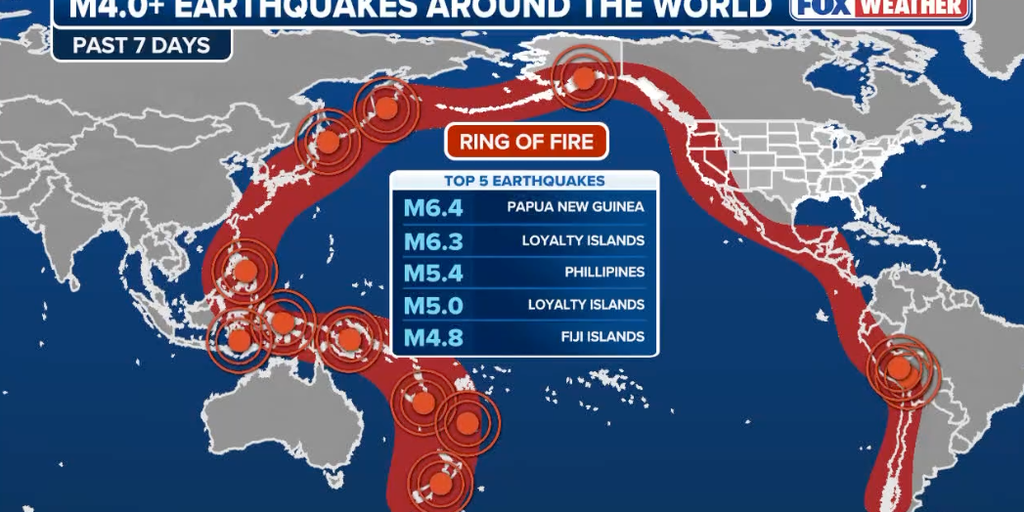
FOX Weather shared a graphic (a pictured chart) that shows all the magnitude 4.0+ earthquakes around the world in the past week. This helps us see that ground shaking is actually pretty common!
No Damage or Giant Waves Reported
The good news is that nothing bad was reported right away:
- There were no immediate reports of damage (like broken buildings).
- The U.S. Tsunami Warning System (a team that watches for huge ocean waves) said there was no tsunami threat (a tsunami is a giant sea wave caused by quakes) for:
- Guam
- American Samoa
- Hawaii
Wait – Earthquakes in the U.S. East Too?
You might think only the western U.S. (like California) gets earthquakes. But a note from a featured video reminds us:
Did You Know? While you may think quakes are a western US problem, some of the largest temblors (that’s just a fancy word for earthquakes) in US history have happened in the East!
Other Related Stories Mentioned
The original news also pointed to a couple of other topics you could read about:
- How to Watch FOX Weather – a way to keep up with weather and earth news on TV.
- One of America’s Most Dangerous Fault Lines Is at Its Highest Stress Level in Over 1,000 Years – a report about a crack in the Earth’s surface in America that is extra stretched and tense.
Summary
A strong magnitude 6.3 earthquake shook the ocean near New Caledonia, deep only 6 miles and early in the morning. It happened in the Pacific Ring of Fire, where most of the world’s quakes occur. Luckily, no damage or tsunami threat was reported for nearby U.S. areas like Hawaii. Also, remember that big earthquakes have struck the eastern U.S. too, not just the west. A map showed many quakes worldwide just last week!
FAQ
Q1: What does “magnitude 6.3” mean?
A: Magnitude is a number that measures how powerful an earthquake is. A 6.3 is a fairly strong shake, but in this case no damage was seen.
Q2: What is the Pacific Ring of Fire?
A: It’s a 25,000-mile-long belt of volcanoes and earthquake zones around much of the Pacific Ocean, and about 90% of the world’s earthquakes happen there.
Q3: Why wasn’t there a tsunami warning?
A: The U.S. Tsunami Warning System checked and said the quake did not create a dangerous tsunami for Guam, American Samoa, or Hawaii, and no immediate damage was reported.
Q4: Are earthquakes only a problem in western United States?
A: No! Although many people think so, some of the largest earthquakes (temblors) in U.S. history have actually happened in the East.
Q5: What did the FOX Weather graphic show?
A: It displayed all the magnitude 4.0 and stronger earthquakes that happened around the world in the past week, giving a visual of how often the ground shakes.