 11
11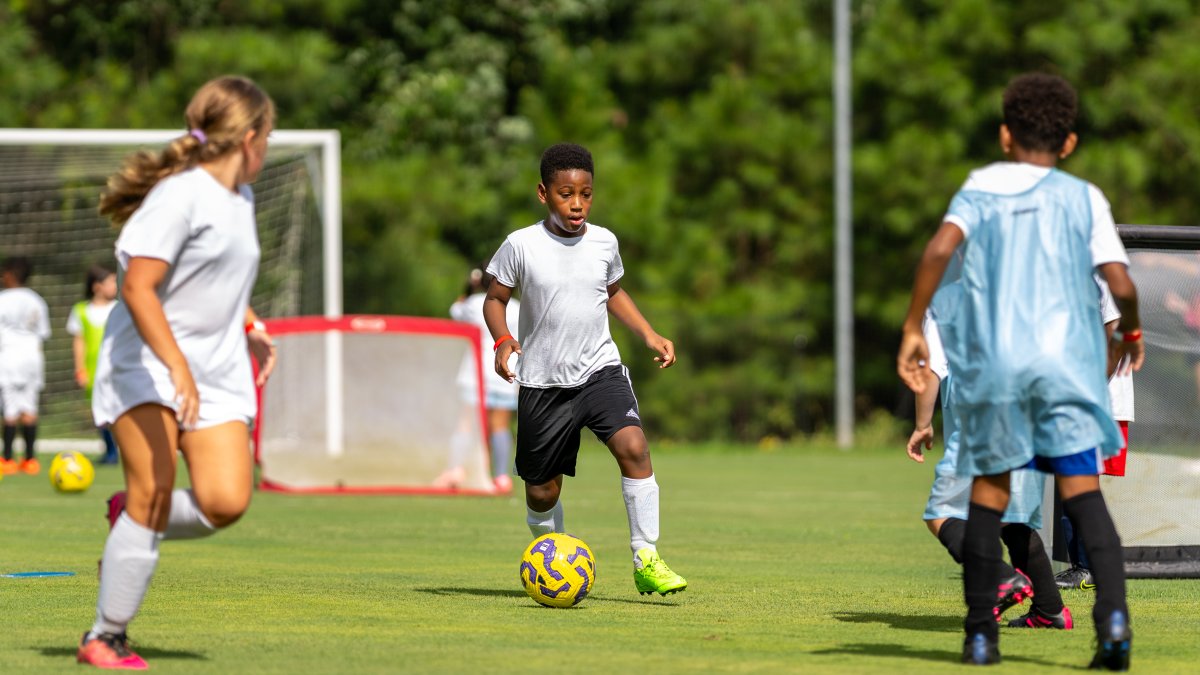
Imagine your favorite playground — the place where you play with your friends every single day — suddenly might disappear. That’s exactly what’s happening at Eric Casiano Park in Kensington, Philadelphia.
A local soccer club has been practicing there for over 30 years. That’s a really, really long time — longer than most of their parents have been alive! But now, some local officials want to tear this green space down and build new homes instead.
Kurt Carlson, who works for the Kensington Soccer Club (a nonprofit that organizes soccer programs for kids), says they’re fighting an "uphill battle" just to keep a simple patch of grass where kids can run around and play.
Here’s why developers want that land so badly: Philadelphia is currently experiencing a historic housing boom. That means people are building thousands of new homes all across the city right now.
But there’s a big downside: neighborhoods like Kensington are already short on green spaces, and they keep disappearing. Stephanie Santiago, a parent at the club, says this trend means fewer and fewer places for kids to simply go outside, run around, and be kids.
Important Point: Even though over 1,800 new soccer fields have been created in the Philadelphia region since 2014, they aren’t spread out equally. Some neighborhoods get lots of new fields, while others — especially communities of color and lower-income areas — still struggle to find any place to play at all.
You might think, "Okay, there are more fields now — problem solved, right?" Not exactly. Here’s why:
According to Lex Chalat from the U.S. Soccer Foundation, about 28 million children in the United States don’t have a place to play within walking distance of where they live. That’s almost as many people as the entire state of California!
Meet Inter Philly FC, a club with three teams across Philadelphia. They play seven-on-seven games, which are perfect for younger kids. But almost every soccer field out there is built for the standard eleven-on-eleven match — the grown-up version with a full team on each side.
So where do they play? As one director, Wendy Smith, put it — they’re just hoping to find a patch of grass that isn’t too bumpy. They even had to buy and set up their own field lights so kids could practice at night!
Here’s a number that might shock you: 70% of kids quit playing sports by age 14, and this is especially true for kids from underserved communities. Outdoor soccer participation hit an all-time high in 2025 (nearly 16 million people playing!), but the dropout rate is still enormous. So what’s going on?
In many countries around the world, soccer is seen as the "people’s sport" — cheap, easy to set up, and available to anyone with a ball and some space. But in the United States, soccer works differently.
Most youth soccer clubs operate on what’s called a pay-to-play model. That means families have to pay serious money for their kids to participate. According to the Aspen Institute’s 2025 State of Play report, the average American family now spends $1,016 per year on their child’s primary sport. That’s nearly 50% more than it was just five years ago.
For "travel soccer" — the competitive leagues where teams go to tournaments in different cities — costs can climb all the way up to $4,000 per player. That’s like buying a used car!
Tyler Adams, the captain of the U.S. Men’s National Soccer Team at the 2022 FIFA World Cup, grew up in New York and experienced these challenges firsthand. He suspects that by age 14, the costs become overwhelming:
One parent from Kensington Soccer Club, Cary Nieves, put it this way:
"I do see that children have a hard time affording their own equipment, just paying dues or affording uniforms, because it is a challenging city."
For some families, even basics like soccer cleats, shin guards, and uniforms are a financial stretch. Some kids don’t even know affordable programs exist because nobody tells them. And as public schools face budget cuts, they’re eliminating after-school sports programs — taking away one of the few free options available.
The good news is, some organizations are working hard to make soccer more accessible. The Kensington Soccer Club, for example, keeps its travel program incredibly affordable — around $80 — and provides gently used cleats, free shin guards, extra socks, and uniforms so families don’t have to buy everything new.
But the challenge remains huge.
Let’s look at the numbers more closely, because they tell a powerful story.
Researchers looked at zip codes across the Greater Philadelphia region and found something disturbing:
| What They Found | Details |
|---|---|
| More fields than ever | There are roughly 7x more fields per elementary-aged child than in 2014 |
| But unevenly distributed | Most new fields are in predominantly white neighborhoods |
| In mostly white areas | About 373 kids share one soccer field |
| In mostly non-white areas | About 927 kids share one soccer field — that’s 2.5 times more crowded |
In some places — like one zip code in Norristown — as many as 5,801 children share just TWO soccer fields. Can you imagine how crowded that would be?
Having a field nearby doesn’t automatically mean kids can use it. Here are some reasons why:
Tyler Adams remembers this from his own childhood:
"I wouldn’t say that anywhere in America really has direct access to soccer pitches unless you live in a major city. For me, it was always walking down to a park and making the baseball field the ‘ideal’ soccer field, or we’d play on the concrete of a basketball court."
It’s not just about money. Research from McKinsey and the U.S. Soccer Federation found that Latino and Black children are three times more likely than white children to quit soccer because they feel unwelcome. That means even when fields exist, some kids walk away because the culture around the sport doesn’t include them.
This isn’t just a Philadelphia problem. It’s a nationwide issue.
According to the Trust for Public Land, in the 100 largest U.S. cities, neighborhoods of color have on average only about half as much park space as predominantly white neighborhoods.
Even worse, less than 1% of America’s 90,000 public schools have schoolyards that are green, welcoming, and open to the community outside of school hours.
Important Point: The lack of soccer fields is part of a much bigger problem — the inequitable distribution of safe, clean, welcoming public spaces across America.
People are starting to fight back. Here’s some of what’s happening:
Ahead of the 2026 FIFA World Cup, Philadelphia Soccer 2026 teamed up with the U.S. Soccer Foundation to build 10 mini-pitches in the region. These smaller fields can fit into tight urban spaces and give kids a place to play right in their own neighborhoods.
Lex Chalat from the U.S. Soccer Foundation says real accessibility requires fixing everything — not just one piece:
"It’s not only public policy, it’s not only lack of investment, it’s not only a representation issue or a socioeconomic issue — it’s everything. The key piece is making sure it’s sustainable, that it’s community centered, and that it’s accessible. And that’s not an easy thing to do."
Several groups are already tackling this:
Tyler Adams sees both the challenge and the opportunity:
"In those inner-city communities, they go through a lot of obstacles that not every kid in the suburbs has to go through. I think there’s a lot of opportunity to do more wrong sometimes than there is good. It’s about inspiring them and remembering to find their reason why."
Here are the key takeaways from everything we just learned:
Q: Why is soccer so much more expensive in the U.S. than in other countries?
A: Most other countries have government-funded youth sports programs where local clubs recruit talent for free. In the U.S., most youth soccer runs on a pay-to-play model — meaning families must cover registration fees, equipment, travel, and tournament costs themselves.
Q: Are there really 1,800 new soccer fields in my area?
A: If you live in the Greater Philadelphia region, yes — but the key word is region. Those fields aren’t spread evenly, and kids in some neighborhoods still have almost nowhere to play.
Q: What can parents do if they can’t afford competitive soccer?
A: Look for nonprofit organizations like Kensington Soccer Club, Street Soccer USA, or local community programs. Many offer free or very low-cost registration, plus free equipment (cleats, shin guards, uniforms) to help families save money.
Q: Why does it matter if kids quit soccer at age 14?
A: When kids quit sports early, they miss out on physical health benefits, social connections, leadership development, and — for a lucky few — athletic scholarships that could help pay for college. The high costs of competitive sports create a system where talent gets lost simply because of money.
Q: What is the U.S. Soccer Foundation doing about this?
A: Through its Soccer Forward initiative, the foundation is building mini-pitches in underserved neighborhoods, funding community soccer programs, and pushing for policy changes that make soccer truly accessible to every child — regardless of race, income, or zip code.
Data analyzed in this article was drawn from OpenStreetMap (2014 and 2026) and U.S. Census American Community Survey estimates (2014 and 2024). Analysis was limited to zip codes served by NBC and Telemundo Philadelphia.