 11
11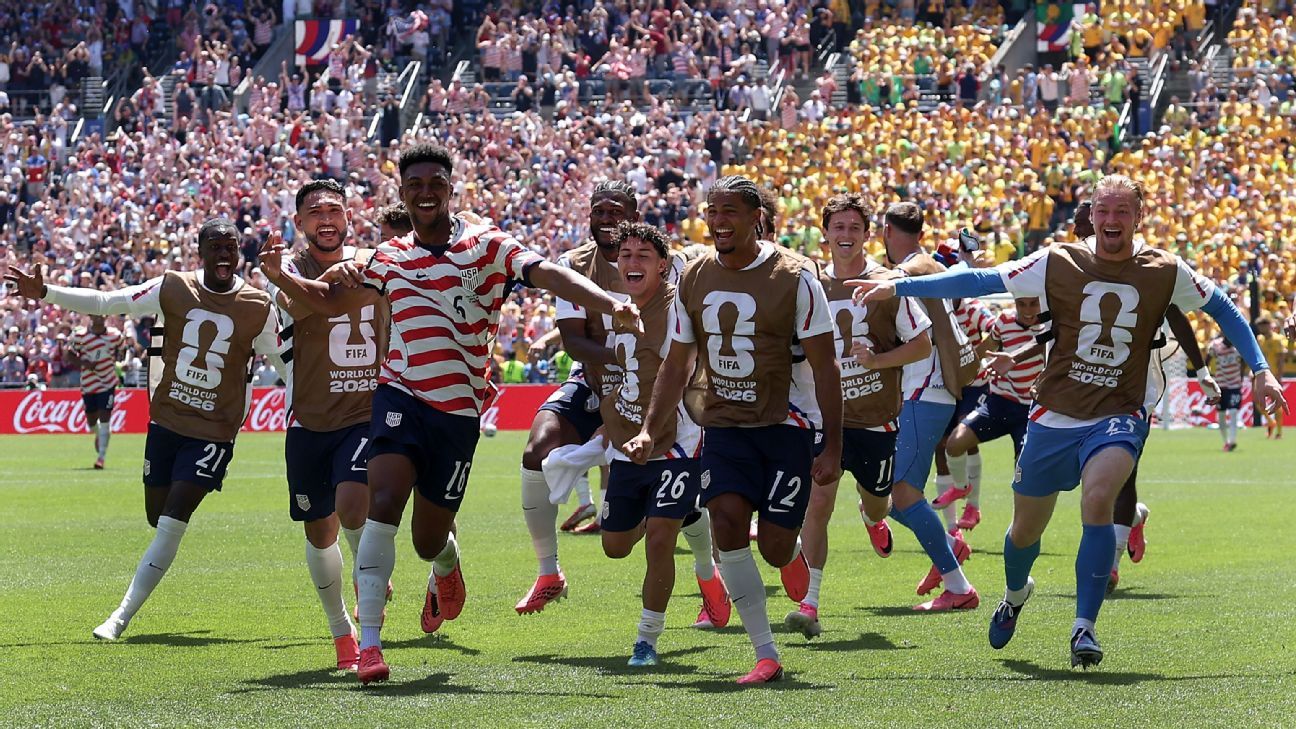
If you haven’t been paying attention to soccer lately, you might be wondering why everyone in the United States suddenly seems obsessed with the U.S. Men’s National Team (USMNT). The answer? Something pretty special is happening.
The 2026 World Cup is being hosted right here in the U.S. (along with Mexico and Canada), and Team America isn’t just showing up — they’re turning heads. Celebrities like Leonardo DiCaprio, Brad Pitt, and Paris Hilton are filling stadium seats. The whole country is tuning in. And a team that many people used to overlook is suddenly looking like a serious contender.
So what’s actually going on? ESPN sat down with a group of soccer experts — former players, managers, and analysts — to break it all down. Let’s walk through what they said, step by step.
This isn’t just any World Cup. This is the largest World Cup in history, expanded to 48 teams (up from 32). The U.S. was expected to get through their group stage, which included Paraguay, Australia, and Türkiye. But actually winning the whole thing? Most people weren’t betting on that.
Still, here’s the thing: the U.S. has never made it past the quarterfinals in the modern era. Their best run was back in 2002, when they lost to Germany in the quarterfinals. In 2014 and 2022, they were knocked out in the round of 16. So history tells us this team tends to hit a wall at a certain point.
Now, with the round-of-32 match against Bosnia-Herzegovina coming up, the question on everyone’s mind is: How far can this team really go?
The experts had a LOT of good things to say. Let’s break it down.
Phil Neville, former England player and experienced manager, said the U.S. has been "probably in the top three or four best teams" at this World Cup when it comes to tactics, style of play, and overall quality. He pointed out that the team looks like they’re genuinely having fun — and that excitement is contagious, not just on the field but across the whole country.
Nick Cushing, a current manager who has worked in American soccer for years, said this is "the best version of the USMNT" he’s ever seen. From the very first game, the team came out with:
Several experts zeroed in on the U.S. midfield three: Tyler Adams, Malik Tillman, and Weston McKennie. Here’s what makes them special:
Nedum Onuoha summed it up: "All three working in tandem has been the thing that surprised me most."
Players like Folarin Balogun (who has been called "simply outstanding"), Sergiño Dest, Antonee "Jedi" Robinson, and Alex Freeman have all drawn praise. Even goalkeeper Matt Freese has been highlighted as "a really top goalkeeper."
Several experts noted that manager Mauricio Pochettino has instilled real tactical discipline. Hugo Sanchez pointed out that while previous U.S. matches (especially friendlies) sometimes looked unfocused, this World Cup version is strategically sharp, disciplined, and dangerous to opponents.
Important Point: One thing the U.S. team has been quietly deadly at during this tournament is set pieces — that’s free kicks, corners, and other dead-ball situations.
Against Türkiye, the U.S. scored from a set play, and their second goal came from a second phase of a set play (meaning the ball wasn’t cleared and they struck again). Nick Cushing pointed out that in tournament soccer, set pieces are often the difference between winning and losing in tight games. The U.S. has clearly done their homework here.
The honest answer? Mixed, but mostly positive.
One interesting point: Pochettino made some rotation changes in the Türkiye game, resting some starters. Several experts praised this move as smart — it keeps players fresh, builds squad harmony, and ensures that if injuries happen in the knockout rounds, everyone is match-ready.
Mauricio Pochettino is the manager (coach) of the USMNT, and his impact cannot be overstated. Here’s why the experts think he’s been a game-changer:
Shaka Hislop, who openly admitted he was one of Pochettino’s critics before the tournament, has completely changed his tune. He said: "Things have been very settled, so he’s been very good indeed."
This is where it gets fun. The experts have different opinions, but here’s the range of predictions:
| Expert | Prediction |
|---|---|
| Phil Neville | Quarterfinals, Semifinals — "if they can dream really big" |
| Hugo Sanchez | Sneak into the top eight — quarterfinals is realistic |
| Shaka Hislop | Can give anybody a run for their money; quarterfinals expected |
| Stewart Robson | Quarterfinals (home teams always perform better historically) |
| Jared Borgetti | Quarterfinals — opponents ahead are manageable |
| Nick Cushing | Didn’t pick a round, but believes they can compete with anyone |
| Nedum Onuoha | They’ll likely become underdogs as competition gets tougher |
| Ricardo Ferretti | Will win next match, but exit in the round of 16 |
| Jan Fjørtoft | At least one more round |
Important Point: History shows that host nations tend to overperform. Think England in 1966, West Germany in 1974, or Argentina in 1978 — playing at home gives teams a real, measurable boost.
Nedum Onuoha offered a word of caution though: as the tournament progresses, the U.S. will face teams that are better at neutralizing their star players — for example, if Pulisic is marked tightly or McKennie is tracked closely, can the team still produce? That’s the real test.
Phil Neville put it beautifully: if the U.S. reaches the quarterfinals or semifinals, "soccer in America will change forever." Players’ lives would be transformed. The sport’s landscape would shift permanently.
Here’s what you need to know in plain English:
The U.S. Men’s National Team is having a World Cup run that nobody fully expected. Year after year, Team America has been the squad everyone kind of shrugged at. But in 2026, at home, with a world-class manager at the helm, this team is different. They play with intensity, joy, and precision. They’re organized. They have balance. And the entire country is starting to believe.
Will they win the World Cup? Probably not — most experts think they’ll fall somewhere between the round of 16 and the quarterfinals, with some daring to dream of the semis. But one thing is crystal clear: Team America has finally arrived on the world stage, and the soccer world is paying attention.
Whether you’re a lifelong fan or someone who’s never watched a match, right might be the perfect time to start.
Q: Why is the USMNT getting so much attention right now?
A: The 2026 World Cup is being hosted in the United States (along with Mexico and Canada), and the team has been playing at an unexpectedly high level. Celebrities are showing up to games, crowds are huge, and the whole country is developing soccer fever.
Q: Who is Mauricio Pochettino and why does he matter?
A: Pochettino is the head coach (manager) of the USMNT. He’s one of the most respected soccer managers in the world, having managed top European clubs and played in World Cups himself. He’s credited with transforming the team’s discipline, togetherness, and overall performance. Several experts called hiring him a "masterstroke."
Q: How far has the USMNT ever gone in a World Cup?
A: Their best result in the modern era was reaching the quarterfinals in 2002, where they lost to Germany. In 2014 and 2022, they were eliminated in the round of 16.
Q: What are set pieces, and why are they important?
A: Set pieces are situations where the ball is restarted from a fixed position — like corner kicks, free kicks, or throw-ins. They’re important in tournaments because many games are decided by just one goal, and a well-executed set piece can be the difference between winning and losing. The U.S. has been particularly good at scoring from them in this World Cup.
Q: Does playing at home actually help a team?
A: Yes! History shows that host nations tend to perform significantly better than they would on neutral ground. Examples include England winning in 1966, West Germany winning in 1974, and Argentina winning in 1978. The energy from a home crowd, familiarity with conditions, and national momentum all contribute to this boost.